Полная версия
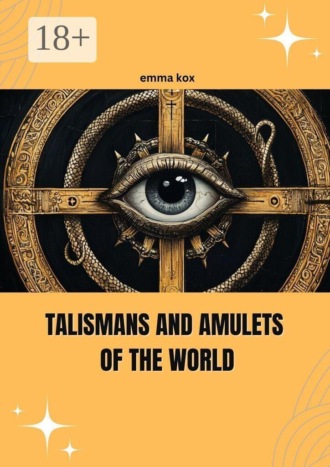
Talismans and amuletes of the world
Find an item that your hand naturally reaches for.
It could be anything — a button, coin, key. A stick, feather, pebble, a broken pendant, a shard of glass, or even a scrap of old paper. There are no rules. Only your subconscious intuition matters. Then bring the item home. Cleanse it.
Ask it: “Why have you come into my life?” Write down your sensations, images, and thoughts. Give the object a name or a purpose. Begin carrying it with you, and observe what changes.
The important thing is that you’re not simply choosing a talisman — you’re learning to see magic where others see trash. This is the first step into real witchcraft — subtle, quiet, alive. You now know: every object is a story, waiting for you to begin telling it. In the next chapter, we’ll explore what materials are best for making talismans and amulets, which ones enhance specific energies, and how to choose what resonates with you. But for now — open that drawer of odds and ends. There, among the coins, rings, notes, buttons, and shells, your first real talisman might already be waiting.
You walk through the room. Maybe in your pajamas. Maybe holding a cup of tea.
Everything around you feels familiar — the book at the edge of the table, the scarf someone left behind, the little figurine that’s been on the shelf since childhood. You live among things — every day — and rarely think of them as alive.
But they remember. Each object is a quiet witness. It absorbs — and stores. Words. Touch. Glances. The scent of your hands. The whisper of sleep. The joy of victories. The pain of goodbyes.
Some objects know more about you than you do yourself. That’s why the magic of objects isn’t fantasy. It’s the art of remembering that things are not just dead matter. They are containers of meaning. Anchors for the soul. Portals to intuition. One person wears a feather — and suddenly feels light, as if they can breathe freely again. Another keeps a smooth black stone in their pocket — and in moments of anxiety, grips it like a lifeline.
Someone wears an old key on a string around their neck — a reminder that every door eventually opens. Magic doesn’t begin in the object — it begins in you. But the object becomes a mirror — for your intention, your belief, your energy.
You can take an ordinary twig — and turn it into a channel for calm.
You can string an old coin onto a thread — and it becomes a strength anchor when everything else falls apart.
You can, like in childhood, find a “treasure” in the grass — and it becomes the start of a new chapter in your life.
You are the creator of meaning — and therefore, of magic. In this chapter, you’ve learned about sympathetic magic, which connects like to like, and contact magic, in which an object that touches you becomes a part of you.
You’ve realized that color, shape, and material are not just aesthetic — they’re a language for the subconscious. And that every object holds the potential to become more than it appears — if you give it a piece of yourself.
In Chapter Two, you’ll go deeper. We’ll explore what makes a strong talisman:
— Which stones ground you, and which ones open your intuition.
— Which metals amplify willpower, and which ones protect.
— Which shapes lead to healing, and which awaken the drive to act.
You’ll begin choosing not just objects — but allies.
And you’ll know why they chose you back. And remember, that true talismans are not bought — they are found, created, or recognized. And most often — in the most unexpected places. Maybe even right now, as you read these lines.
Maybe your eyes already landed on something nearby — and your heart fluttered for no reason. Or perhaps — for the most important reason of all.
Chapter 2: Symbols and Archetypes
Universal Symbols
The cross, circle, eye, and snake are universal symbols — eternal images that speak to everyone. Sometimes you look at a simple line, a carving on an old pendant, or a strange illustration in a book — and feel that there’s something more than just a pattern. It’s as if your soul remembers that this is important, even if your mind cannot yet explain it.
There are symbols that humanity has seen since the very beginning of its history — in dreams, on rocks, in rituals, in adornments, on bodies. They come from the depths, from a shared field that unites us all — regardless of language, culture, or faith. These symbols are universal. Let’s follow them — step by step, like ancient traces — and try to understand what exactly they awaken in us.
Step 1. The Cross — Intersection of Paths, Union of Worlds
The cross is not just a religious sign. It is a crossroads. It is the point where two axes meet: the vertical — symbolizing the path of the spirit, and the horizontal — symbolizing the path of earthly life. When you see a cross, it’s as if you are standing at a junction: Where are you? Who are you? Where do you go next?
The cross can be a symbol of meeting and balance, or a symbol of sacrifice and transformation, or a protective amulet guarding from all directions. In different cultures, it represents different concepts. For example, among the ancient Slavs, the cross was a solar symbol — a sign of the Sun, of life, and of strength. In Christianity, the cross became the symbol of crucifixion — but also of resurrection. Among the Celts, the solar cross united sky and earth, humanity and eternity. When you wear a cross, you are not simply wearing a symbol. You carry within you a point of balance. You remind yourself: “I stand between the past and the future, between spirit and body — and I choose consciously.”
Step 2. The Circle — Eternity, Wholeness, Protection
Stand in the middle of a field. Around you is mist. But draw a circle on the ground — and you’ll feel that inside, it becomes quieter. More peaceful. Safer.
The circle is a home. It is an egg. It is the universe. It has no beginning and no end — and that’s why it speaks of eternity. The circle is always closed, which means it protects. The circle is symmetrical, which means it is perfectly harmonious. What can be seen in the circle?
In architecture: the circle is a dome, a round temple, a labyrinth.
In rituals: the circle is always a magical circle, a circle of power.
In nature: the circle is the moon, the sun, an eye, the ring of a tree, a droplet of water. And in the human body: the circle is the pupil, the navel, the crown of the head. Because of its qualities, wearing a circular amulet — like a pendant, ring, or bracelet — can help restore inner wholeness, bring you back to yourself after stress, and protect you from external chaos. The circle is like a closed breath: inhale — and exhale, again and again. It says: “You are already whole. You are not broken. You are part of a greater circle. Everything passes — and everything returns.”
Step 3. The Eye — Knowledge, Protection, Insight
Have you ever felt like someone was watching you, even if no one was around?
Have you ever “pierced” someone with your gaze — and they turned away? The eye is more than just an organ — it is a symbol of consciousness. The eye sees what is hidden, it guides, and it protects. The eye appears:
— In Egypt — as Wadjet, the Eye of Horus, a symbol of healing, victory, and divine watchfulness;
— In the East — as the Eye of Fatima (Hamsa), warding off the evil eye and envy;
— In Christianity — as the all-seeing eye of God inside a triangle;
— In esotericism — as the third eye, the center of intuition, vision, and premonition.
When you use the symbol of the eye, you say:
“I see. I am awakened. I am protected.” Eye talismans are often hung at the entrance of a home, worn by children, or carried when one needs to be especially alert — to signs, to people, to events. It is the eye that looks inward. And it teaches us to look — consciously and honestly.
Step 4. The Snake — Transformation, Wisdom, Life Force
The snake always represents transformation, wisdom, and the power of life.
It is a symbol that consistently evokes a strong emotional response. Some fear it, others admire it — both reactions are valid and accurate.
The snake is an ancient archetype that represents not only danger but also rebirth. It sheds its skin and becomes new again. The snake lies coiled, but in an instant, it can strike forward like lightning. It knows both poison and healing.
In cultures around the world, the snake has held many meanings.
In Indian tradition, it is Kundalini, the energy coiled at the base of the spine.
To the Aztecs, the feathered serpent Quetzalcoatl is the god of knowledge and creation. In Greek culture, the Asclepian snake is a symbol of medicine and healing. In the Bible, the serpent from the Garden of Eden represents temptation and knowledge.
When you wear or use the image of the snake, you are inviting transformation into your life — even if it is painful. You are welcoming wisdom born of experience, the strength to survive and to renew. You say: “I am not afraid to change. I know my strength. I am both darkness and light, life and death. And all of it lives within me.”
Final Note: How to Work with Symbols
Symbols are like keys.
They don’t work simply because you see them — they work because you feel them.
So if you’re choosing a symbol for an amulet, a tattoo, a drawing, or a ritual — listen closely. What resonates within you? Where in your body do you feel warmth, vibration, or curiosity? What image “sticks” to you, as if it’s waiting to be recognized? Remember, that a symbol is a bridge — between the inner and the outer, between the human and the archetype, between “I don’t know” and “I remember.” And once you find your symbol, it will begin speaking to you in a language that does not need words.
Practice: Find Your Symbol
Sometimes a symbol finds you.
It appears in a dream.
It repeats itself throughout your day — in the ring of a stranger, in an advertisement, on the cover of a book. That’s not a coincidence. That’s a calling. But if you’re not sure yet what your symbol is, you can go out and meet it halfway. Step by step:
— Find a quiet place. You may play soft wordless music or light a candle.
— Take a sheet of paper, a pen, and — if you’d like — images of symbols (you can print a cross, circle, eye, snake, or others).
— Close your eyes and breathe deeply. Tune in to a sense of inner truth.
— Take five slow breaths — in and out.
— Feel your body. Feel your heart. Feel the center of your chest.
— Imagine you are surrounded by white light.
Now open your eyes and look at the symbols. Don’t think — just observe and feel.
Which ones spark a strange interest in you? A sense of curiosity, even excitement?
Which one feels like “it’s meant for me”?
Choose one symbol. Place your hand over your heart and quietly ask:
“What do you want to tell me?” Give yourself some time.
Sometimes you’ll receive words, images, feelings — or simply a sense of warmth or knowing. Write down everything you felt, even if it seems strange.
This is the language of the archetype — it rarely sounds logical, but it always speaks deep truth.
Interpretations (if you chose one):
The Cross
You are standing at a crossroads. A decision must be made. This symbol points to the possibility of balance between the spiritual and the material.
Perhaps you’re too much in your head — it’s time to return to your body.
Or maybe you’re stuck in routine, and your soul is asking for growth.
The Circle
You are going through an important cycle. Everything comes back around.
Maybe you’ve completed something — and it’s time to let go.
Or, on the contrary — it’s time to gather yourself together.
The symbol suggests: you don’t need to chase after anything — you’re already at the center.
The Eye
Your inner vision is awakening.
You feel more than you see.
You may be intuitively “reading” people and situations, but still hesitate to fully trust yourself.
It’s time to open your third eye — and trust the signs.
The Snake
You are on the threshold of transformation.
Perhaps the old skin has become too tight — it’s time to shed it.
This is a symbol of change, but also of healing.
Do not fear the pain — through it, you are becoming your new self.
It’s worth considering a real-life example of how a symbol becomes a personal talisman. There was a woman, passionate about yoga and Eastern philosophy, who had long struggled to find a talisman. She was drawn to gemstones and complex symbols — but nothing truly “clicked.” One day, at a flea market, she found an old coin engraved with an eye — someone had carved the symbol by hand, directly into the metal. She picked up the coin — and instantly felt a response in her body. Since then, she always carries it with her. And every time she feels anxious, she takes the coin in her hand — and it’s as if she comes back to herself. She says: “This is my eye. It always looks where my truth is.”
The essence of the story is this when you can spend hours studying meanings, books, cultures. But your true symbol — you feel it in your body and heart. It could be an image from your childhood, a line on your palm, a dream, a tattoo on someone else, or a drawing in the sand. Because a symbol is not just a shape — it’s an echo of something ancient within you. And one day, in the most ordinary moment, you’ll suddenly see it — and realize: “I’ve always known you. I just forgot your name.”
Table of Universal Symbols and Their Meanings


How to Use This Table:
— Intuitive Selection
— Read the names of the symbols. Close your eyes and feel — which one “lit up” first? That’s your active archetype.
— Talisman
— You can draw the chosen symbol, carve it, engrave it on jewelry, or carry it with you. It becomes a personal tuning key.
— Meditation
— Visualize the symbol before sleep or in stillness. Let it reveal to you something you don’t yet know about yourself.
— Rituals and Practices
— Include the symbol in your circle of power, altar, wish notes — it will amplify the energy of your intention.
Bonus: Creating Your Personal Symbol
If you don’t just want to choose a symbol but create your own unique sign, begin by recalling an important moment in your life—
a time when you felt power, awakening, or a sense of wonder.
What was present in that moment? A line? A shape? An object?
Draw it. Let it be a simple figure: a line, a loop, a dot, a wave, an arrow.
Don’t think about making it beautiful — think about making it honest.
Now add to what you’ve drawn.
Maybe a dot appears in the center of a circle. Or a zigzag — like a lightning strike.
This is your inner geometry. Now give it a name: “The Sign of Clarity,” “The Key to Self,” “The Bridge to Light.” The name activates the symbol.
A Guided Process to Create Your Personal Symbol
Let’s go through a short psychological process to help uncover your deeper intentions — and discover the kind of symbolism that will resonate with you and spark the right energy.
Step 1: Reflection
Begin by asking yourself What moments in your life feel the most meaningful or important? Were there times when you felt powerful, confident — or underwent transformation? When was the last time you felt like “everything is in its place”? The answers to these questions will help you identify which area of your life or inner self needs to be supported or strengthened through your symbol.
For example:
— Strength and confidence can be reflected in straight lines, triangles, black and red shades.
— Harmony and balance might show through circles, flowing lines, green and blue colors.
— Transformation and growth often manifest in spirals, snakes, and nature-based elements.
So tune in. What will your symbol show you?
Step 2: Visualization
Close your eyes and imagine you’re standing in front of a blank canvas.
What’s the first shape you want to draw? Will the lines be straight or wavy?
What color or texture comes to mind first? How many elements should your symbol contain? A single line? A few shapes? Or a more complex composition? Remember: a symbol can be simple and minimal — even just one line.
The most powerful symbols often appear “small” but contain great energy.
Step 3: The Magic of Elements
Now think about the materials and elements that might be important in your symbol. You can use the four natural elements: Earth, Water, Fire, Air is each can be represented by a shape (e.g. spiral for water, triangle for fire). Or consider animals — symbols from the animal kingdom can also become part of your sign
(e.g. serpent, eagle, bear, wolf). You might also be drawn to stones or metals if you seek strength or protection, use symbolism connected to iron, crystals, or rocks.
Sacred Geometry and the Symbols of the Elements and Planets
When you look at a snowflake under a microscope, or the spiral of a seashell,
or ancient carvings etched in stone — you’re seeing geometry that’s not random.
You sense a deep order behind it, as though the Universe itself is drawing its laws on the surface of the world. This is sacred geometry — an ancient understanding that forms hold power. Not just beauty, but energy, meaning, resonance. It’s a system of archetypal shapes that repeat everywhere — from the structure of molecules to planetary orbits. People have used sacred geometry for thousands of years — in magic, architecture, mysticism, and ritual because these shapes vibrate with our subconscious. They are imprinted in us. Sacred geometry is the language of energy through form.
Example: The Flower of Life
One of the most well-known sacred geometry symbols is the Flower of Life—
an ancient symbol found in Egypt, India, and China. It’s made of many overlapping circles forming a flower-like pattern. But it’s more than just beautiful.
It is a creation matrix, a formula of space, a molecular structure, a law of growth. The Flower of Life is used in meditation and to align with harmony.
It also functions as energetic protection (especially in amulets), and as the basis for sacred constructions — pyramids, temples, mandalas.
Triangle
Three points, three sides — and here we have the foundation of matter and spirit.
Pointing upward, the triangle is a symbol of fire, motion, willpower, and divine origin.
Pointing downward, it represents water, receptivity, the feminine, and the chalice.
When combined, the two triangles form the six-pointed star — a sign of balance and harmony between the masculine and the feminine.
Spiral
In a seashell, in a galaxy, in the curl of DNA — the spiral form carries the code of growth and development.
This is a path that does not move in a straight line, but in circles — deeper, higher, and farther each time.
The spiral is a symbol of the soul’s journey, inner movement, and the evolution of consciousness.
Where does this show up in reality?
For example, in Gothic cathedrals, all proportions are built according to the golden ratio, where each line “sings” its own vibration.
In crystals and mandalas, repetitive symmetries help the mind align with calm and centering.
In personal talismans, the spiral enhances the process of transformation, the triangle empowers will, and the circle offers protection.
Elemental Symbols: How Nature Speaks to Us
Earth, Water, Fire, Air — you’ve known them since childhood.
But in truth, they are not just “elements.”
They are forces, archetypes, programs of nature that live within us.
Each element has its own symbol, shape, and sensation.
And we can use them — for tuning, for balance, for magic. Let’s take a closer look at how the elemental signs are used in talismans and amulets:
Earth
Shape: A square or downward-pointing triangle with a horizontal line
Color: Green or brown
Earth stands for stability, grounding, care, the body, and boundaries.
The Earth symbol in a talisman gives grounding, confidence, and resilience.
Example: A clay pendant with a square pattern is great for someone who wants to feel grounded and rooted.
Fire
Shape: An upward-pointing triangle
Color: Red, orange, gold
Fire symbolizes energy, will, passion, movement, destruction, and transformation.
The Fire sign in an amulet helps awaken courage, ignite desire, and burn away the old.
Example: A tattoo with a fire triangle suits someone beginning a new chapter in life.
Water
Shape: A downward-pointing triangle
Color: Blue, turquoise, silver
Water represents emotions, intuition, flow, healing, and the feminine principle.
The Water symbol opens sensitivity, forgiveness, and inner vision.
Example: A pendant with lapis lazuli shaped like a droplet can be a guide for dreams and emotions.
Air
Shape: An upward-pointing triangle with a horizontal line
Color: White, yellow, gray
Air symbolizes thought, freedom, inspiration, ideas, and breath.
The Air symbol brings mental clarity, freedom from old patterns, and fresh perspective.
Example: An amulet with a feather and an engraved Air symbol is ideal for a writer or student.
Planetary Symbols: Rhythms of the Sky
Planets are not just astronomical bodies.
They are living archetypes, influencing us on deep levels — our thinking, passions, mission, fears, and desires.
Each planet has its own symbol, and wearing this symbol (or using it in a talisman) attunes us to its energy. Let’s take a closer look:
Sun — The center, will, identity.
Symbol: A circle with a dot.
Brings charisma, creative impulse, warmth, and inner radiance.
Moon — Subconscious, emotions.
Symbol: Crescent moon.