Полная версия
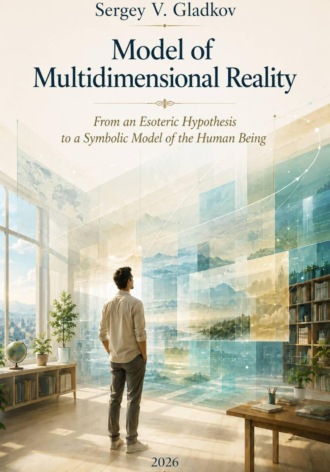
Model of Multidimensional Reality
Some say:
"Science has not discovered the spiritual world, therefore it does not exist."
Others answer:
"Science cannot disprove the spiritual world, therefore it exists."
Both phrases are too strong.
The natural sciences work with observable evidence, measurements, testable consequences, reproducible procedures, and models that can be refined and corrected. This is not a weakness. It is the source of their strength.
The scientific method requires us to seek explanations that can be related to experience and subjected to testing.
This rule is sometimes called methodological naturalism.
It is important to hear both words.
Methodological, because we are speaking about a way of investigation.
Naturalism, because scientific explanation seeks regularities of the natural world and testable connections between phenomena.
But it does not follow from this that science has automatically proved the complete composition of reality.
The claim "only the material world exists" no longer belongs only to method. It is a philosophical position about what exists at all. It can be discussed, defended, criticized, accepted or not accepted. But it cannot be quietly presented as a simple consequence of scientific procedure.
Nor can the reverse move be made.
If the scientific method neither confirms nor refutes the spiritual aspect in its general form, this does not turn the spiritual aspect into a proven fact.
The boundary of a method is not secret proof of metaphysics.
In this book, the dual-aspect view of the world will be named directly: it is the initial authorial position.
Not a scientific conclusion.
Not a required belief for the reader.
Not a loophole that allows any claim to be protected from testing.
But the chosen point from which the further reflection begins.
Two Languages That Must Not Be Confused
Scientific language and esoteric language can meet in one book.
But meeting does not mean merging.
They do different work.
Scientific language asks:
what is observed?
what measurements are available?
what explanation can be tested?
what data could support or weaken the hypothesis?
can the result be reproduced?
Esoteric language often works differently.
It asks:
what image helps express an experience?
how does a person make sense of an inner path?
what symbols can speak about the connection between body, meaning, suffering, task, and wholeness?
how does a tradition preserve an experience that is difficult to fit into ordinary concepts?
Both languages can be important.
But they do not become identical simply because they are used side by side.
If a chakra is described as a cultural or spiritual map of a bodily-experiential zone, this is one mode of conversation.
If a chakra is declared to be a physical organ that controls a gland through an unproven channel, that is already a different claim. It requires data, a mechanism, and testing.
If the monad is used as an image of an individual program or as a question about the continuation of patterns, this is one mode.
If the monad is declared to be a proven entity that transfers the same subject between incarnations, that is already an ontological claim.
If the cosmos is used as an image of a person's inclusion in a wider order, this is one mode.
If the position of the planets is declared to be a proven mechanism for recording personality in the genome, that is another mode.
The main task of the book is not to ban the second mode forever.
It is simpler:
do not present it as the first without grounds.
Analogy Is Not Mechanism
Analogy has a special power.
It allows us to see similarity where before there were only separate fragments.
A city can help us understand a system without a single center.
Language can help us understand a stability maintained by many participants.
An ecosystem can help us see that order does not always need a governing observer.
M-theory can offer an image of hidden dimensionality.
The esoteric map of subtle bodies can offer an image of the hidden multilevel nature of the human being.
But analogy does not transfer properties automatically.
A city is not a human being.
A human being is not an ecosystem in the literal sense.
An additional dimension does not become a subtle body simply because two descriptions can be placed side by side.
Seven levels in one scheme do not prove seven levels in another.
Analogy opens a question.
A mechanism must withstand testing.
This boundary is especially important for the Model of Multidimensional Reality. Its central gesture is built on a comparison:
seven additional dimensions
and
seven subtle bodies.
Within the authorial model, such a comparison is permissible.
It may be strong.
It may help organize the further narrative.
It may become the architecture of a reflection on the human being.
But it does not become a physical conclusion.
That is why the book will return periodically to the same formula:
structural similarity does not prove ontological identity.
Quantum Duality: A Useful Example and a Dangerous Temptation
Quantum physics turns especially easily into rhetorical ornament.
One only has to pronounce the words "wave," "particle," "observer," "quantum," and the text immediately acquires the appearance of depth. Sometimes a promise is added to this appearance: since physics itself is strange, almost any metaphysical claim becomes plausible.
But the strangeness of physics is not permission to say anything at all.
Light and matter really can display wave-like and particle-like properties under different experimental conditions. Matter waves were proposed by Louis de Broglie in the first half of the 1920s. The diffraction behavior of electrons was demonstrated experimentally in 1927. Later, interference effects were observed for atoms and complex molecules.
This is not the latest sensation.
It is part of the history of quantum mechanics.
And physics does not simply stare helplessly at duality. Quantum theory successfully describes and predicts the corresponding phenomena, even if the classical images of wave and particle, taken separately, do not provide a convenient everyday picture.
There is another temptation.
The word "observation" may be heard as if human consciousness, by its gaze, forces a quantum object to choose its behavior.
But in scientific conversation, the point is experimental configuration, measurement, physical interaction, and the coupling of a system with its environment. Quantum effects can become unobservable because of decoherence: interaction with the environment disrupts the possibility of seeing interference.
Therefore quantum duality can enter this book only as a limited analogy.
It reminds us:
reality is not always exhausted by one familiar way of describing it.
But it does not prove:
the spiritual aspect of the world;
subtle bodies;
the monad;
reincarnation;
the influence of the observer's consciousness on the physical result.
There is no impoverishment in this limitation.
On the contrary.
When analogy stops pretending to be proof, it becomes more honest and stronger.
What It Means to Build an Authorial Model
The Model of Multidimensional Reality is not a scientific theory in the strict sense.
But it is not obliged to disappear simply because it cannot immediately be turned into a set of experimental claims.
It has another task.
It offers a coherent architecture of the question.
Can we consider the human being as a system in which the material and spiritual aspects do not exclude one another?
Can we connect the ancestral basis, the entry environment, the personal program, the repetition of life scenarios, and the inner task without declaring this connection to be a proven mechanism?
Can we use subtle bodies as seven levels of a speculative map of experience?
Can we speak of karma not as cosmic punishment, but as a language of repeating incompletion?
Can we speak of fate not as a sentence, but as an image of an individual trajectory?
Can we speak of the monad not as an immortal observer, but as an ultimate symbol of a personal program?
The answer of this book will not sound like "yes, this is how reality is arranged."
The answer is more careful:
let us try to build a model and see what it can hold.
Where does it help us pose the question more precisely?
Where does it create unexpected connections?
Where does it begin to contradict itself?
Where does it return an entity that can be removed?
Where does it turn a symbol into a thing?
Where does it stop explaining and merely begin naming?
An authorial model has the right to exist if it does not require the reader to confuse it with proven knowledge.
A Few Rules Before the Road
Now the rules can be formulated directly.
First.
Do not present a hypothesis as fact.
Second.
Do not use a scientific term as an ornament meant to make the reader believe in an unproven connection.
Third.
Do not turn a symbol into anatomy, physics, or a biological mechanism without data.
Fourth.
Do not take internal elegance as proof of truth.
Fifth.
Do not bring back the hidden observer.
If an explanation requires introducing a separate, unchanging I that secretly governs processes, we need to check whether it can be removed while the model remains intact.
Sixth.
Do not introduce an immortal personality under a new name.
Monad, soul, trace, meta-personality, pattern - these words must not be used as masks for an entity accepted in advance.
Seventh.
Do not promise healing where there is only an image, a practice of self-observation, or a hypothesis.
Eighth.
Do not make the boundary of the scientific method into proof of metaphysics.
Ninth.
Do not make physical duality into proof of the spiritual aspect.
Tenth.
Preserve the reader's right not to accept the model literally.
These rules should not hang over the book like a prohibition sign.
They are needed as handrails on a difficult staircase.
Further on, the book will be able to speak more boldly precisely because it knows where the edge lies.
Here an Objection Arises
The reader may ask:
"Why read a theory that itself admits it is speculative? If this is not proof, would it not be simpler to leave it in the realm of personal fantasy?"
The question is fair.
Some fantasies really are better kept to oneself.
Not every coherent system deserves a book.
Not every strong intuition withstands meeting another person.
Not every image helps us see.
But between a proven theory and a random fantasy there is a space of disciplined reflection.
In this space, a person can build models that do not require immediate belief, but help ask questions more precisely.
Such a model can be used temporarily.
It can be tested for internal coherence.
One can look for places where it becomes too convenient.
One can compare it with existing explanations.
One can separate what is already known from what is only imagined.
One can let go of parts that do not withstand criticism.
One can preserve an image if it helps us see experience without turning it into dogma.
It is in this mode that the Model of Multidimensional Reality will unfold further.
Not as a finished map of the Universe.
But as an authorial attempt to walk the difficult edge between reduction and arbitrariness.
Which Level to Begin With
After all these distinctions, a natural question arises:
where should the model itself begin?
We could move at once to subtle bodies, chakras, the monad, the cosmos, fate.
But then the book would violate its own rules.
We need to begin with the most reliable level.
With the body.
The body is not an obstacle to a spiritual conversation.
It is not a lower step that must be hurriedly left behind.
It is the first way in which life becomes concrete.
Through the body, a person enters the world.
Through the body, one experiences fatigue and strength, anxiety and peace, closeness and threat.
Through the body, one encounters heredity, environment, age, limitation, recovery.
Through the body, experience gains density.
And if we want to build a multilevel model, we cannot begin with the invisible as if the visible no longer mattered.
The next chapter will begin with the body.
Not because a human being is reducible to the body.
But because a large model must first learn not to lose the ground beneath its feet.

The Body and the Biological Basis
The Morning That Begins Before Thought
Sometimes a person wakes up already tired.
Nothing has happened yet.
The day has not had time to present a single task. No one has called. No message has arrived that could spoil the mood. There has been no conversation after which one has to recover for a long time. Not a single thought about the future has appeared.
But the body already knows something before thought.
The shoulders are tense.
The breathing has become short.
The heart is working a little faster than one would like.
Sleep has left behind not clarity, but heaviness.
On another morning, the same person wakes differently. Outwardly, their life has not changed. The room is the same. The same city is outside the window. Unresolved questions have not disappeared. But the body is gathered. It does not demand an immediate explanation. It simply gives support: one can get up, make breakfast, leave the house, think about something difficult not from a state of defense, but from a state of presence.
Between these two mornings lies more than a difference in mood.
The body participates in what the world becomes.
When a person is hungry, a conversation is heard differently.
When they have not slept for several nights, someone else's phrase more easily turns into a threat.
When the back hurts, the distance to the store feels longer.
When strength returns after an illness, an ordinary walk suddenly becomes an event.
When breathing is free and movement comes easily, the future looks a little wider.
We are used to speaking about the body as if it were transport for the real person.
There is a driver.
There is a vehicle.
The driver thinks, chooses, loves, fears, makes mistakes, searches for meaning.
The vehicle carries them through the world, sometimes breaks down and requires maintenance.
This image is convenient.
And it is almost certainly too simple.
Because a person does not simply use the body.
They experience through it.
A person does not receive a body after their personality has already been fully formed somewhere else. Their first ways of meeting the world arise inside bodily organization: in the rhythms of sleep and wakefulness, in sensitivity to noise and touch, in the speed of recovery, in the reaction to the unknown, in the ability to withstand tension, in the need to come closer or step back.
Even the highest question about purpose is not asked by a bodiless voice.
It is asked by a living person.
A person who has a nervous system, memory, age, fatigue, habits, family history, lived events, and a body that never remains completely on the sidelines.
The previous chapter ended with a simple rule:
if we are going to speak about the invisible, we must first not lose the visible.
Therefore the conversation about the Model of Multidimensional Reality begins not with the monad.
Not with the cosmos.
Not with subtle bodies.
It begins with what is closest.
With the body.
What a Person Did Not Choose
No one chooses the starting point of their bodily trajectory.
A person does not choose the height they will have to live with.
Does not choose eye color.
Does not choose the pace of growing up.
Does not choose the inborn features of the organism.
Does not choose whether they will easily endure lack of sleep or need several days to recover after one difficult night.
Does not choose the first sensitivity to a loud voice, sharp light, loneliness, touch, a change of place.
Does not choose their parents.
Does not choose what combination of parental genetic material will become the beginning of their bodily trajectory.
This does not mean that destiny has already been written.
But it does mean that life does not begin from a blank page.
Two children may grow up in similar conditions and still meet the same world differently.
One quickly tires of many people and looks for quiet.
Another comes alive in noise and movement.
One takes a long time to get used to a new room, a new caregiver, a new routine.
Another switches easily and almost immediately begins exploring the space.
One reacts sharply to a remark.
Another seems not to notice it, and a few minutes later is busy again with their own affairs.
Such differences do not need to be explained immediately by a single cause.
Inborn features, early environment, relationships with adults, random events, health, learning, and family culture may all take part in them. Later, a person's own decisions will join them, along with their ways of coping with difficulties, their experience of success and defeat.
But the fact itself remains important:
a person enters life not as pure consciousness handed a standard shell.
Their bodily basis has features from the very beginning.
Everyone has their own range.
Not a ready-made sentence.
Not an unchanging scenario.
But a range of possibilities, vulnerabilities, and ways of responding to what happens.
This is visible not only in childhood.
One adult can work for several hours in a crowded space and preserve clarity.
Another needs a long silence after such a day.
One easily lives without a strict routine.
Another, after missing sleep and food, quickly loses the ability to make calm decisions.
One person wants to talk immediately after a conflict.
Another first needs to walk, feel the ground under their feet, return breathing to its ordinary rhythm, and only then look for words.
We often judge these differences morally.
We call one person strong and another weak.
One collected and another lazy.
One open and another cold.
Sometimes such judgments are only partly fair.
Because not every difference is the result of conscious choice.
Before choice, there is a basis from which choice is made.
Heredity Without a Sentence
One of the first levels of scientific conversation about the biological basis is heredity.
A person receives genetic material from their parents. The DNA sequence matters for the development of the organism. It participates in the formation of many traits and biological processes.
This is a real layer.
It does not need to be mystified in order for its depth to be seen.
But this is exactly where the first dangerous simplicity appears.
One can imagine the genome as a book in which the whole person has already been written in advance.
Here is the chapter on temperament.
Here is the chapter on illnesses.
Here is the chapter on abilities.
Here is the chapter on future mistakes.
Here is the chapter on love.
Here is the chapter on destiny.
All that remains is to turn the pages in the appointed order.
This image is attractive because it removes the anxiety of uncertainty.
If everything has already been written, a person does not need to understand why their life unfolded in exactly this way.
But biology is more complex.
DNA is not a finished literary text of personality.
It does not contain a detailed biography inside itself.
It does not store a list of future meetings.
It does not explain why two people with similar possibilities make different decisions.
It does not determine in advance who will one day risk changing professions, who will forgive an old hurt, who will remain in destructive relationships, and who will leave.
Even when a genetic feature noticeably affects the organism, a person's path is not reduced to one line of code.
The organism develops.
It interacts with the environment.
Cells specialize.
Systems regulate one another.
Experience leaves traces.
Learning changes the available ways of acting.
Relationships can intensify vulnerability or give support.
Chance does not disappear either.
Therefore heredity is better understood not as a sentence, but as one of the layers of initial conditions.
It does not determine the whole road.
It participates in the terrain through which one will have to walk.
Why the Word "Program" Requires Caution
In conversations about the human being, the word "program" is often heard.
It seems precise.
Genetic program.
Behavioral program.
Ancestral program.
Life program.
Karmic program.
But the same word quietly connects different things.
When a biologist speaks of a genetic program, they may mean a complex system of inherited information and regulation in the development of the organism.
When a person speaks of an ancestral program, they often mean repeating family scenarios: ways of dealing with closeness, conflict, money, power, care, fear, silence.
When a personal program appears in an esoteric conversation, the subject may already be the presumed task of incarnation.
These meanings cannot be placed in one box simply because a common word has been found for them.
In this book, the word "program" will be used carefully.
The body really does have biological organization.
Heredity really does participate in development.
The family environment really does transmit ways of responding to a person, even when no one formulates them aloud.
But it does not follow from this that karma, destiny, or the monad are already written inside DNA.
Nor does another conclusion follow:
that a person is a biological robot merely carrying out an instruction once loaded into them.
The robot metaphor can be useful only for a short time.
It reminds us that a significant part of processes happens without conscious control.
We do not give the heart a separate command before each beat.
We do not manually distribute hormonal signals.
We do not choose every muscle contraction while walking.
We do not decide which cell should renew itself today.
Even in behavior, much happens automatically.
A person may open an app without noticing when the hand reached for the phone.
May repeat a familiar phrase from a parent and only after the conversation hear its tone in their own voice.
May again choose the same way of defending themselves, although many times they promised themselves to respond differently.
But automaticity is not the same as complete preprogramming.
A robot, in the everyday sense, performs a given set of instructions.
A living person develops in an environment, learns, changes, creates new connections, makes mistakes, notices their own repetitions, and sometimes is able to stop and choose a different response.
They are not free from their basis.
But they are not exhausted by it either.
Regulation: Why DNA Alone Is Not Enough
There is another reason not to turn heredity into destiny.
In a living organism, what matters is not only what DNA sequence exists, but also how gene activity is regulated.