Полная версия
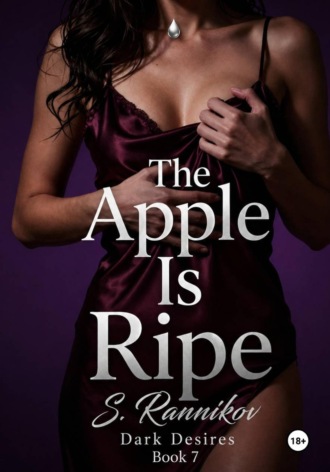
The apple is ripe

Stepan Rannikov
The apple is ripe
“One brush against her in the crowd, and the world tilts forever. A tale of forbidden fruit, where the sweetest sin is the one you can’t resist.”
PROLOGUE
“You have to tell Valera everything, Lyuba. I’m telling you this as your sister.”
“Have you lost your mind, Lena?” Lyuba’s voice hit a frantic pitch. “Just saying it out loud to you nearly killed me from shame.”
She began fanning her chest with her hand — rapid, desperate movements — before reaching for the bottle. She tilted it and splashed more of the homemade wine into her glass.
Lena watched her, her gaze sharp and unblinking, then took a slow sip of her own. The wine was young, bright, with that tart snap of fresh apples. It went down easy.
“The man is a predator, plain and simple,” Lena said, her tone hardening.
She sliced into a ruby-skinned apple, the blade sinking through the rosy flesh with a crisp thwack. She chewed thoughtfully, her eyes never leaving her sister.
“He’s riding the bus, prowling, putting his hands on women. It’s only a matter of time before he graduates from touching to attacking. And after that? He’ll do whatever the hell he pleases.”
CHAPTER 1
The two bags of apples were dead weight. The thin plastic handles bit into Lyuba’s palms like wire as she trudged from the orchard toward the bus stop. Her arms felt elongated, strained to the breaking point.
“If I could just sit,” she thought.
Her eyes fixed on the horizon where the battered silhouette of the commuter bus rattled toward her through the heat haze.
It had been Saveliy Grigorievich Yasin’s idea. He was a relic of the HR department, a retiree who couldn’t quite bring himself to leave the factory for good. They were cafeteria acquaintances — the kind who shared a table in silence or exchanged pleasantries over lukewarm soup.
“Lyubochka, do you have any use for apples?” he’d asked her recently, just after the Apple Savior feast. “For juice, for wine. Or just for the sake of having something sweet to bite into.”
Lyuba had shifted on her feet, a flush of awkwardness rising to her cheeks.
“Oh, now, Saveliy Grigorievich. I couldn't possibly. It’s too much trouble.”
“Listen to me,” the old man insisted, his voice thinning. “I have the cottage. My parents’ place. It’s getting to be too much for me — the garden is going to seed, Lyuba. It’s in Pokhmelki, barely ten kilometers out. The buses run every hour.”
He paused, a world of unspoken fatigue in his eyes.
“Talk to your husband. I’ll give you the keys. I even have a juicer tucked away in the shed. You should use it.”
“Thank you,” she had murmured, touched by the sudden weight of his generosity. “I’ll speak with him.”
That first Saturday Lyuba had ventured to the village with Valery. They needed to scout the place, and besides, she needed a man there — if only for the quiet reassurance of his presence. Together they’d harvested a bounty of crisp tart apples. Four bags bursting at the seams. They’d even lugged a juicer back home.
All through Sunday she’d labored over the fruit alone. September was breathing down her neck. Time was a luxury she didn't have. Then, on Friday, Valery made his move. He was going fishing on Saturday.
“How can you, Valery?” Lyuba asked, her voice sinking. “I can only haul two bags on my own. Even then, I’ll practically tear my arms out of their sockets.”
“They aren't going anywhere. They’ll hang there until November if they have to. Just carry what you can.”
Valery muttered, his attention fixed on the stove as he stirred a thick slurry of pea porridge for bait.
So there she was: a woman transformed into a pack animal, lugging those monstrous bags alone. True to her nature, she’d stuffed them to the absolute limit. By the time she reached the station, her legs felt like leaden weights, paralyzed by the strain.
The commuter bus pulled into the bus station. From there, it was just five trolley stops home. Comfortably settled into the back seat of the half-empty bus, her bags on the floor at her feet, Lyuba thought she could certainly make it through these five stops. Maybe even standing.
And so it happened. She had to stand. The trolley was a cage of sardines, packed tight despite the Saturday hour.
“Where is everyone going at five-thirty on a Saturday?” she wondered, her irritation rising as she swayed in the aisle.
She managed to wedge the bags between her legs, stacking one atop the other, pinning them with her knees until the top bag was swallowed by the hem of her skirt. Gripping the overhead handrail with both hands, she braced herself, turning rigid as stone.
Everything was sticking to her. Her dress, her panties, her bra — all of it damp and cloying. Sweat traced cold lines down her back, her neck, her thighs.
“You fool,” she thought, “spreading your legs for a pile of apples.”
She stood there, stretched out like a prisoner on the rack, unable to retreat. As the trolleybus jolted, a memory flickered to life — sharp and intrusive. She saw her grandfather back in the village, preparing a plucked chicken. He’d use a contraption of his own making, a set of metal skewers that stretched the bird taut. He was so proud of that invention.
Once marinated, the bird — soaked, glistening, and stretched square on the frame — was ready. He could lay it over the coals, simmering it low and slow, or crush the carcass under a heavy iron press until it hissed against the flames.
She remembered how his fingers would slip between the bird's legs, slicking them with sauce. He’d lick his lips, muttering,
“Oh, how delicious, how good.”
Young Lyuba had watched, mesmerized, as the chicken’s belly swelled, yielding to the slide of the man’s wet palm. When he pulled his hand away, his fingers left glistening streaks of sauce across the bird’s thighs.
The image had seared itself into the twelve-year-old girl’s mind. She hadn't felt fear; she had felt something deeper, something primal. She had imagined herself as that bird. Drip-drop. Splash.
“I just have to hold on,” she told herself now, pulling back to the present. “I’ll get off at my stop. I’ll find a bench. I’ll just sit.”
The crowd began to churn, shoulders shoving past her toward the doors. They pressed against her, jarring her frozen frame.
“I’m getting out. I have to hold the apples.” Lyuba clamped her thighs around the top bag, her body reacting with an instinctive, rhythmic clench — squeezing her muscles tight, holding herself together against the weight.
***
She was thirty-seven, and her world had the blurred, repetitive edges of a long-faded photograph. She and Valery had been sweethearts since their school days — the kind of inevitable pairing that happens in small towns. At eighteen, they’d traded their childhood bedrooms for a corner of his parents' house. Valery was her first; he was her only. He was the single map she had ever been given to navigate the world of men.
Lyuba was childless. She poured her stifled maternal instincts into her sister’s grown sons, but lately, the heavy grit of routine had begun to wear her down. A quiet sense of worthlessness had taken root in her chest, a hollow ache that suggested she was surplus to her own life. Everything had gone gray. Her world was a closed loop: the factory floor, the silent dinner table with Valery, the boisterous but exhausting visits to her sister. She told herself she needed a hobby — a women’s club, a community center, a place to belong. But deep down, in the quiet places she didn't like to visit, she knew a macramé class wasn't the cure for this kind of starvation.
She didn't want a hobby. She wanted to be caught.
The only time she felt truly alive was when she was drowning in shame or trembling with fear. Those were her demons, and they were hungry. She wasn't looking for an affair — she wasn't built for that kind of betrayal. She was a product of a “simple Russian family,” as the old books put it, raised on a diet of modesty and restraint. Yet, the mere thought of a casual encounter with a stranger made her blood run hot. She would blush until her skin stung, pushing the shame away even as she pulled it closer, reveling in the suffocation of it.
She craved the danger of a gaze held too long. She wanted the anxiety of a secret, the frantic need to justify herself to her husband, to weep and say, “Nothing happened, it was just a friendship,” even as her heart hammered against her ribs. She didn't even need the sex. The fallout was the point. The proximity to the fire was enough.
And then there was the matter of her skin. "Sensitive to touch" felt like too clinical a phrase, too modern for the fading echoes of the Soviet era. To Lyuba, it felt more like she had been born without a top layer of dermis, her nerves raw and humming, exposed to the open air. The pads of her thumbs, the delicate blue veins of her wrists, the pale hollows of her elbows — they were all live wires.
She felt a hot flash of embarrassment even thinking about the other places. A stray brush against her skin could leave her weak, a sudden dampness blooming between her thighs that felt both humiliating and exquisite. She knew that if a man — the right man — were to grip her hips, she would come apart. She would be clay in his hands.
Ironically, her husband’s touch did nothing. Valery was a man of habit, not heat. He didn't caress; he performed. He satisfied himself with a quick, rhythmic efficiency — three times a month, like a scheduled maintenance check. That was her life: a quiet house, a cold bed, and a soul waiting for a spark that might finally burn it all down.
Конец ознакомительного фрагмента.
Текст предоставлен ООО «Литрес».
Прочитайте эту книгу целиком, купив полную легальную версию на Литрес.
Безопасно оплатить книгу можно банковской картой Visa, MasterCard, Maestro, со счета мобильного телефона, с платежного терминала, в салоне МТС или Связной, через PayPal, WebMoney, Яндекс.Деньги, QIWI Кошелек, бонусными картами или другим удобным Вам способом.