

Полная версия
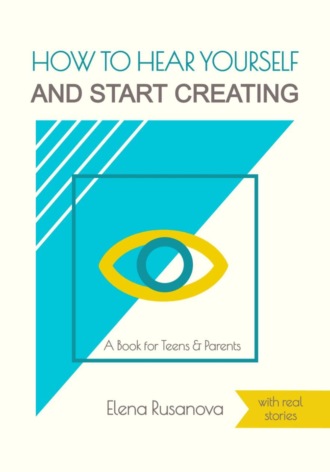
How to Hear Yourself and Start Creating

Elena Rusanova
How to Hear Yourself and Start Creating
Acknowledgments
To the teachers who see children as they truly are - free, luminous, and not meant to be fitted in. To my children, and to the heroes of this book, who follow their spark wherever it leads, even when the world pulls the other way…
Preface
Hello, dear reader!
My name is Elena, and I'm a mother of two sons, as well as a former HR and career consulting professional. After a fascinating journey full of ups and downs and unexpected shifts in reality, I started writing - revealing and highlighting the opportunities that surround us.
I'm a trained psychologist, which no longer scares anyone the way it used to. Even schoolchildren and students now come to psychological sessions and training without embarrassment. It's becoming just another form of understanding - one that allows you to face your fears, the "cockroaches in your head," your beliefs, solve a problem, or look at a conflict from a different angle.
All we really want in life is to be happy, to feel lightness and joy as natural, basic states.
But how do we achieve that? No one told us. Unlike the constant presence of suffering, pain, and melancholy - all the shades of which are regularly fed to us through news, film, and literature. The phrase "Life is pain" has become a catchphrase for many, like a well-known meme.
The ability to dwell in a state of joy, happiness, and harmony is the first thing we should think about and learn. This - not the pursuit of success or the "hunger games" of survival that external pressure and other people's narratives try to impose on us. They scare us into thinking that without chasing that "carrot," life has no meaning.
Throughout my professional career, I've often asked myself: “Who am I, and what is my talent?” And if at first glance it's not as obvious as, say, the striking talent of an artist or musician - something immediately clear - then it's hard to decide. So, possessing seemingly standard qualities like "you're quick-witted, cheerful, playful, a good communicator, and well-organized," you start focusing on external influences and what the system tells you.
I've tried many things in my life: a corporate career as a top manager, consulting, working in startups, infopreneurship, and numerous other businesses and investments - including, for example, selling candles and perfumes through marketplaces. I've always eagerly responded to the various opportunities offered by trends and external tendencies. And I kept waiting for outside clues about what to do next, what skills and abilities the system and the service market would like me to acquire.
But in the end, I understood only one thing: no one outside will ever truly tell you what you need to do or what your talent - that very spark - is. Neither tests, nor guides, nor teachers, nor employers will tell you your place in this world.
You can only reach it by yourself and alone with yourself.
The system can "circulate" you as a clear participant in the social order - a waiter at a bar, a delivery driver, or any other position precisely defined by the labor market. It manages society's needs based on supply and demand, fashions, and trends that suggest, for example, that there are enough financiers right now, so you should go into IT. It insistently recommends choosing a field that's in demand, not one that comes from the heart. It forces you to listen to outside advice, analytical calculations, and statistics - rather than your own heart, natural talents, and gifts.

You may not fit into others' expectations...
But another way is possible - the path of freedom and creativity in its broadest sense. Creativity from the heart. The spark you discover for yourself.
In this book, I will reveal the basic steps and possibilities for exactly that. I will draw closer to the treasured depths and the priceless core that resides within each of us. I'm sure this will reach you at the perfect moment - depending on your soul's readiness and your ability to hear and respond. Just try to read and perceive with an open heart. And if something stirs active resistance, then it's not yet time; don't rush. Everything has its time...
A Few Words on Tomorrow
"What defines a transformer is not the cog in his chest but the spark that resides in their core. A spark that gives you the will to make your world better". (Alpha Trion in Transformers One)
The world is changing at an incredible rate. And you, dear reader, are seeing this every day.
Technologies are taking over spaces where previously only humans were. Artificial intelligence is becoming ingrained into our lives and work, reminiscent of the plot of the movie "Terminator," only without the apocalyptic ending. Schoolchildren and students are writing essays, theses, and term papers using neural networks, creating videos and photos, replacing human voices and faces with avatars.
Social networks have become a replacement for television, and we spend more and more time endlessly scrolling through TikTok and other feeds. We get our news from Telegram channels and chats. And our thumbs are so toned that any bodybuilder would envy them.
New professions entering the labor market are surprising with their popularity, widespread response, and taking top spots on the list of top specialties. YouTube bloggers and TikTokers are riding the wave and often earning more than other professions.
Fresh schoolchildren can become fascinated with cryptocurrency, delving into the intricacies of mining or working with exchanges. Young and young alike are actively exploring artificial intelligence, using it in social media marketing, copywriting, and blogging. My seven-year-old son is already creating 3D spaces in Roblox Studio, having previously learned Scratch as a more intuitive block-based programming language. Former actors are becoming quest or performance animators, embracing the trends of popular TV series like "The Squid Game," "Game of Thrones," and other films that capture our hearts.
And maybe adults don’t like this (especially grandparents), but this is a given of the changes that are happening.

Technology can be used to your advantage or just a waste of time…
We've increasingly begun to think about our free time and hobbies. How can we make our hobbies profitable, so that work isn't torture or boredom, but rather transforms into creativity as a natural part of our existence? A lifetime of employment from 9 to 5 until retirement is no longer the only option for a professional path and a living.
Numerous platforms for gig work and project-based work sites are popping up. And if you draw, write music or lyrics, code, or even play computer games, all of this can generate income, essentially replacing traditional work.
Do you feel like most of the old templates and settings are outdated and no longer relevant? Well, you're right.
Although it’s possible that right now some adult is continuing to tell you that you need to:
– choose a profession once in your life and know exactly who you want to be;
– get a job with an employer, building a career only within their framework, receiving a salary and stability forever;
- to be someone, to define one’s status and calling, and not to waste time on nonsense or suffer through nonsense (insert any other overheard phrase).
All of this merely reflects anxiety and conveys outdated approaches, hidden beneath good intentions, care, and consideration. Anything that doesn't fit into the familiar is immediately considered strange, incomprehensible, and therefore has no place.
Do you know of examples of people your age or adults earning money remotely and living a more free life than those around them? But this is possible; you just need to see the options and directions for growth and not resist the changes that are sweeping away everything old and no longer viable.
First of all, let's take another look at the face possible stereotypes and limitations, which you encounter in one way or another when communicating with adults. What intuitively seems outdated or unworkable to you now, or perhaps you simply know that things can be different.
For example:
– It's important to choose a job for life, one that's useful and socially significant for others. Show up to work on time and leave on time. Take all-inclusive vacations to the countryside or the seaside. Slowly save for a mortgage and pension, so you don't die of poverty in old age. Better yet, start your own garden and tend to it - then you'll definitely never run out of food.
– You need to do something that's understandable and useful to others, something tangible, like building houses or making bricks. Something you can touch and feel. Anything else (blogs, videos, and so on) is like 'selling air,' and therefore, the devil.
– Stability and certainty are important in everything: today one way, tomorrow exactly the same.
– It's best to be where you were born. A well-known proverb reflects this: 'Where you were born, there you'll be of use.' Live in one place, without thinking about other cities or countries. The key is to understand whether this is your own conviction or something imposed on you. After all, you can be happy anywhere; it's just a matter of where your soul calls you, and that's important, too.
– By the last grade in school, you should have already decided on your future profession. Focus on what's fashionable, prestigious, pays well, and is rated by magazines. Once you've enrolled in higher education, stick to it, be consistent in everything, and be results-oriented. If you choose the wrong profession, endure it and reap the rewards.
– Live for your conscience, not for joy. You can't put joy in your wallet, but at least your conscience won't torment you.
– Living in one place and owning a home is essential, just like having a personal car. Otherwise, you're an outcast, and you could end up on the street at any moment, freezing to death under a lamppost.
– A hobby will never feed you, so you have to choose a recognized, normal profession and work in a factory/office/office, like everyone else…
I could go on and on; I think everyone could give their own example of an opinion or stereotype they've heard about life, work, and money that continues to hold them in the tenacious grip of its limitations.

Exercise: “Uncovering Stereotypes and Their Nature”
Here I suggest you stop and do this exercise yourself: Write down any limiting stereotypes you have ever encountered on a piece of paper and next to each one, note where they came from (parents, school, neighbors, relatives, a friend, someone said it on TV)?
In this way, you "separate" yourself from this belief and remember its source ("where the ears are sticking out"), which means you gradually remove the significance of these phrases for yourself. The important thing is simply to begin this process; gradually, you will increasingly notice how many limitations are "in the air."
* * *
But there are other examples:
– The creator of Geometry Dash, a musician and programmer, combined his two passions into a new product that has become a favorite among many children and adults.
– An artist and director who created the animated film "Flow" using the open-source design program Blender. The film even won a coveted Oscar. Creativity knows no bounds.
– Authors of books with a narrow target audience, writing fantasy novels and becoming million-selling authors on Amazon (Alexey Pekhov is an example).
...you can take on lesser-known stories; you don't have to be on everyone's lips! But at the same time, you can maintain a lifestyle and format with much greater freedom than usual:
– a freelance programmer who writes code for several projects from home and earns money from multiple sources simultaneously. He can work from Dubai, Bali, or his dacha in the Moscow region;
– a gaming professional who earns money from competitions and tournaments, as well as from the creation and sale of skins and “virtual gaming equipment”;
- a game technician, a board game or quest story leader, who comes to board game companies as a presenter and expert, including uniting the geek community;
– an artist passionate about blockchain, who exhibits his works as NFTs and sells them to a wide audience. He also takes commissions for custom sketch projects;
– a young investor with an entrepreneurial bent, interested in the stock market, cryptocurrencies, and projects: bought a car, sold it for parts, bought a garage and rented it out, and so on;
– a dancer who leads his own classes or works in theatrical productions of young directors, a participant in youth dance projects;
– a gaming blogger who makes videos about popular games for schoolchildren has found his own style and flair, creating engaging content with humor and memes, monetizing it through video hosting platforms;
– a musician who writes electronic music – rhythms and individual melodies – and sells them on platforms for downloading background music for music videos and videos.
There are many such examples of self-discipline and self-paced creativity. It requires courage and perseverance, as well as a genuine love for one's work.
That's what this book is all about, because hearing your inner voice and what your heart desires is the most important thing. Everything else will follow...

First-hand: “What stereotypes about work, profession, or education have you personally encountered?”
Zakhar, 14 years old:
“Adults or peers in the yard say that work is necessarily boring, tedious, so no one wants to work.”
"That you have to go to college to get a job. As if you can't work without a college degree..."
Ulyana, 12 years old:
"When people tell me, 'If you cook something, you have to clean up all the time. If you don't clean up, then you don't have to cook.' I just don't really like washing dishes, but I love cooking. But when they tell me that, I just give up and don't want to do anything."
Polina, 19 years old:
"That work and a proper career are only serious things, where you sit and do something with an insanely smart and self-important air. And definitely not creativity. Because creativity and hobbies are just a pastime, a diversion, clearly not a calling or a lifelong career."
Vika, mother and creative teacher:
"That you can only achieve a certain position through pulled strings. Even my grandparents always told me, 'They're rich and well-connected, they can afford it.' A creative career, for example: singer, model - it all comes down to networking."
"To earn a lot of money, you need to work hard and for a long time. I had this in mind even with some physical labor."
“That work is some kind of reluctance, constant survival, it cannot be chosen according to your interests, hobbies.”
"That money is bad. Such a typical Soviet stereotype."
"You need to choose a profession that's currently trending and relevant. Those who earn a lot of money today should go to school there. In my time, it was cool to work as an accountant or manager and choose that specialty. For example, a friend of mine studied international relations at a very prestigious university and had a lot of English tutors. And how things turned out for her: she ended up opening her own optical shop. And she loves her business. And yet, she's never worked in her specialty.”
"That a minimum foundation in every subject is absolutely necessary. So, you've chosen your list, you've figured out what you need and what interests you, so why bother cluttering your head with other subjects? For example, I don't know biology and I'm doing just fine, and if I need something, I'll find it and study it. Why waste energy and effort that you could be focusing on your passion, your interests, and, at the same time, passing exams? I'll tell you a story about a group of 100-point students in literature who are currently studying journalism at Moscow State University. A professor gathered them together and asked, "Well, you've all read War and Peace, haven't you?" They were like, "No." Professor: "Then how did you pass the test?" The students replied, "Well, you see, to get a 100% on the Unified State Exam, you don't need to read War and Peace..."
Author's note:
In our age, when you can find any information you need, motivation and interest matter more. The ability to analyze, find what you need, try things for yourself, and gain experience - rather than simply copying memorized phrases and endlessly re-reading theory and rules. In any lecture, when knowledge is being shared, the most important thing isn't what the teacher says, but the state of mind, the experience, and the energy they bring. Think about how much you actually remember from lectures and lessons - and what exactly stays with you?
Let me give you an example: I'm approaching my forties, and I graduated from school long ago, but I still remember a biology lesson when my teacher demonstrated the structure and shape of DNA using a chalkboard wiper. She simply twisted the wiper into a spiral.
This is precisely why many educators today are radically rethinking their approaches to education and the way information is delivered - which is causing a storm of public dissonance among those who are used to the old ways.
The Faces of Creativity
“In the beginning God created heaven and the earth.” (Bible).
We perceive creativity in a one-dimensional way. I propose a broader perspective.
From books and stories of others, we learn that creativity encompasses artistic works, music, art, and even crafts. In kindergarten and school, everyone created countless crafts from autumn fruits, origami, and other creative projects, including macrame. We remember signing up for clubs and sections on knitting, drawing, dancing, clay firing, embroidery, and so on. Some loved these activities, while others pretended to or wasted their time because their parents were forced to send them to the club.
Gradually, creativity came to mean only all of these activities. But this is one of the limitations our minds have created, and in response, we limit ourselves, for example:
– I’m definitely not a creative person, it’s not available to me.
– I don’t have any obvious talent like others.
– I can’t draw/dance/sing and so on, which means my place is somewhere shuffling papers or at the checkout.
"I can't do anything with my hands; everything falls apart and falls out of my hands. I just break everything I touch."
– I find doing things with my hands boring, which means creativity is not for me.
Such phrases and thought forms can become ingrained in the conscious and subconscious of both children and adults, limiting their own search for self-expression. It's tempting to give up and follow the established rut, following other people's instructions, like a conveyor belt carrying out clear, routine operations.
But the magic secret is that everyone can be a creator. Creativity is all around…
The word "creativity" comes from the Latin "creatus" (past participle of "creare" - "to make, to bring forth"), which goes back to the Proto-Indo-European root *"ker-" - meaning "to grow, to cause spring into being, to bring to life."
Thus, the word "creativity" itself is associated with the process of creating a form and giving it a new, unique one.
This means that any new form, whether material (objects) or immaterial (information, for example), is creativity. Wherever a person's thoughts are, a piece of their soul is found. That which we truly love.
And there are no restrictions or accepted lists of places to be in order to meet the creative standard.
Beyond handicrafts, crafts, dance, music, and drawing, it can be any other intellectually creative endeavor. Projects, business, programming, copywriting, writing, blogging, organizing a group for a common cause - all of these are creative endeavors, and therefore possess a creative spark.
Creativity is creation from love, creation from the soul, any creative movement and thought from the heart:
– just an idea, in the form of an impulse that comes to mind, is already creativity. It's up to you to bring it to fruition as the realization of the idea.
– a drawing, text, code, home-grown flowers, an algorithm, a program, a method, hand-crafted fruits or vegetables, an Excel spreadsheet, interior design, or even creating a cozy room.
– anything, starting with the material world, embodied in concrete objects - something that can be assessed, touched and handled with one's own hands, physical achievements in sports, as well as what lies beyond the material world - information, meanings, ideas.
This is not easy for our minds (which are quite conservative by nature) to imagine and think about, especially if you are creating something that has not existed before.
You can even create a mood and a state (... and from this, your own reality).
Yes, yes, don't be surprised, this is the very first creation, immediately available to us. We often forget this as life goes on, thinking that external factors, like bad weather, the exchange rate, or the neighbors' arguments, affect our mood. This is absolutely possible, gradually tapping into our resources, establishing contact with ourselves, and tuning into the day, for example, by practicing in the morning.
When you create every day, being in a state of flow, it’s as if you are carried by an invisible force, because you are doing what you love.
Differences between creativity from the heart and activity from the mind (mental programs and traps):
– The mind is always focused on specific results, deadlines, indicators, and templates for how things should be done. For example, this is the only way to create a video, attract subscribers, and follow a pre-conceived script, deadlines, and regulations. One step to the right, one step to the left – you're shot. This is exactly how our mind thinks and imagines.