



Полная версия
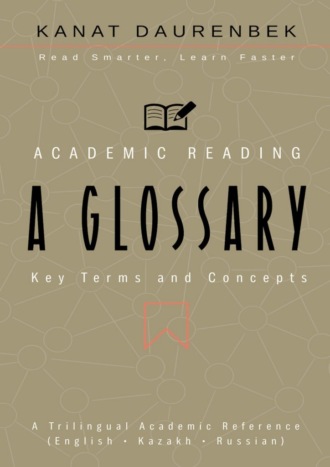
Academic Reading. Key Terms and Concepts: A Glossary. A Trilingual Academic Reference (English • Kazakh • Russian)
Practical implementation / Практикалық іске асыру / Практическая реализация
The process of applying theoretical knowledge, strategies, and techniques of academic reading in specific educational and research situations. It involves adapting learned approaches to the real conditions of working with sources, taking into account the context, objectives, and available resources.
Practical recommendations / Практикалық ұсыныстар / Практические рекомендации
Specific, applicable advice and instructions formulated on the basis of theoretical principles and empirical data, aimed at improving the actual practice of academic reading and writing. In academic texts, the section on practical recommendations ensures the connection between research findings and their practical application.
Practice audit / Тәжірибені аудит ету / Аудит практики
A reflective self-assessment by the reader of their own academic reading practices: regularity, strategies employed, effectiveness, and alignment with established educational or research goals. It serves as a foundation for the purposeful development of reading competencies.
Pre-calibration / Алдын ала калибрлеу / Предварительная калибровка
A preparatory process of adjusting reading expectations, goals, and strategies before beginning work with a specific source, based on preliminary familiarisation with its structure, genre, and complexity. It enables selecting the optimal pace, depth of reading, and annotating system before the main reading commences.
Precise and detailed thought / Нақты және егжей-тегжейлі ой / Точная и детализированная мысль
A characteristic of analytical thinking and academic writing presupposing the precision of formulations, the specificity of the concepts employed, and a sufficient level of detail for the full and justified expression of an idea. It is contrasted with vague, generalised, or unsubstantiated claims; it is a requirement of academic style and a criterion for the quality of analytical text.
Prediction evolution matrix / Болжамдар эволюциясының матрицасы / Матрица эволюции предположений
A tabular tool that records the dynamics of change in the reader’s predictions about the content, argumentation, and conclusions of a text as reading proceeds. It enables the tracking of the process of refining comprehension and develops metacognitive monitoring and predictive reading skills.
Prediction template / Болжамдар үлгісі / Шаблон предположений (Author’s methodological term from the book series)
A structured form or document guiding the reader in formulating reasoned predictions about the content of a text before reading begins: fields for recording initial hypotheses, the sources upon which they are based, and subsequent verification. It ensures systematicity of predictive reading and creates a documented basis for reflection on the accuracy of predictions.
Predictive questions / Болжамдық сұрақтар / Прогностические вопросы
Questions directed towards predicting the development of a text in the course of reading: What will the author argue next? How will this chapter conclude? What conclusion might this research reach? They stimulate the reader’s active engagement with the text, support predictive reading, and reveal the mechanisms of prediction in the early stages of reading.
Predictive reading / Болжамдық оқу / Прогнозирующее чтение
A reading strategy in which the reader systematically formulates, tests, and revises predictions about the development of the author’s thought, the structure of the argumentation, and the future content of the text. It develops critical and analytical thinking, sustains active reader engagement, and promotes deeper comprehension of the source’s logic.
Preferences / Қалаулар / Предпочтения
The individual stable inclinations of the reader towards particular formats, strategies, pace, and conditions of reading. Awareness of reading preferences is important for the strategic planning of academic work; however, it must be combined with flexibility: academic reading requires adaptation to diverse texts and tasks regardless of personal preferences.
Preliminary familiarisation / Алдын ала танысу / Предварительное ознакомление (cf.: Previewing – a more formalised procedure)
Initial informal acquaintance with a source prior to its systematic previewing or detailed reading: reading the title, reviewing the cover, information about the author, and overall length. It forms a primary impression of the content and creates cognitive readiness for subsequent engagement with the text.
Pre-reading strategies / Оқуға дейінгі стратегиялар / Стратегии перед чтением
The set of actions performed before beginning detailed reading: setting goals, activating background knowledge, previewing, formulating anticipatory questions, and selecting the optimal reading strategy. They ensure cognitive preparation, raise the effectiveness of subsequent reading, and reduce the time required for information processing.
Preview / Шолу / Обзор
A generic designation for the technique of rapid familiarisation with a source prior to its detailed reading. It encompasses reviewing the headings, abstract, introduction, and conclusion to determine the text’s relevance, main idea, and structure. It ensures cognitive readiness for the subsequent deep reading.
Previewing / Алдын ала шолу / Предварительный просмотр (Cf.: Preliminary familiarisation – a less formalised initial form)
A structured technique of initial engagement with a text involving the systematic examination of headings, subheadings, the abstract, introduction, conclusions, tables, and illustrations before detailed reading. It ensures the formation of a cognitive schema of the source, facilitating subsequent deep comprehension and annotation.
Primacy effect / Бастапқылық эффекті / Эффект первичности
A cognitive phenomenon in which information encountered at the beginning of a text or sequence is retained more effectively than information encountered later. In academic reading, awareness of the primacy effect is applied to structure texts and to evaluate the reception of argumentation.
Primary focus / Бірінші дәрежелі фокус / Первичный фокус
The principal aspect or problem towards which the main analytical attention of the researcher or reader is directed when working with an academic source. A clear definition of the primary focus ensures the purposefulness of reading, helps avoid the dispersal of attention, and structures the process of annotating and note-taking.
Prior knowledge activation / Бар білімді жаңғырту / Актуализация знаний
A pedagogical technique and cognitive process that restores and activates previously acquired knowledge at the start of engaging with new material. It creates a bridge between existing experience and new content.
Proactive / Проактивті / Проактивный
An adjective characterising behaviour, a strategy, or a disposition oriented towards the prevention of difficulties and the initiative-based management of the educational or research process. In academic reading, the proactive approach is contrasted with the reactive: the reader creates conditions for comprehension in advance rather than seeking solutions after the fact.
Proactive reading / Проактивті оқу / Проактивное чтение
An approach to academic reading in which the reader takes the initiative in managing the process: setting goals in advance, anticipating content, selecting strategies, and creating conditions for optimal comprehension. It is contrasted with reactive reading, in which the reader merely responds passively to the text.
Proactivity / Проактивтілік / Проактивность
A personal and professional disposition involving initiative-taking, anticipatory actions, and the assumption of responsibility for the outcomes of one’s activity rather than reactive responses to circumstances. In academic contexts, proactivity manifests in independent planning of reading practices, posing research questions, and managing the learning process.
Problem areas / Проблемалық аймақтар / Проблемные зоны
Sections or aspects of an academic text or reading strategy that present sustained difficulties for comprehension, analysis, or application. Identifying problem areas is the starting point for purposeful work to address difficulties and develop the corresponding academic skills.
Problematic points / Проблемалық сәттер / Проблемные моменты
Specific points or passages of a text that give rise to difficulty, incomprehension, or critical disagreement for the reader in the course of reading. Unlike problem areas, the emphasis shifts to discrete, localised moments of difficulty rather than systemic zones; their recording during annotating forms the basis for subsequent work to clarify comprehension.
Procedural comments / Процедуралық түсініктемелер / Процедурные комментарии
A type of annotating in which the reader records observations about the methodological procedures, research design, and sequence of steps described in an academic text. They enable tracking the methodological logic of the source and serve as a basis for evaluating the validity of the methods employed.
Process audit / Процесс аудиті / Аудит процесса
A systematic analysis of the sequence and quality of reading actions and strategies applied during engagement with an academic text. It enables the identification of bottlenecks in the reading process and the optimisation of reading behaviour.
Progress tracking journal / Прогресті бақылау күнделігі / Журнал прогресса
A tool for monitoring the reader’s academic development, recording achievements, difficulties, changes in reading strategies, and the dynamics of competency growth. It supports reflective self-assessment and enables the conscious planning of further professional development.
Progressive increase / Прогрессивті арттыру / Прогрессивное увеличение
A principle of gradual escalation of complexity, volume, or intensity in academic activity: the sequential increase of reading speed, depth of annotating, or the number of sources analysed. It ensures the sustained development of academic skills without overloading cognitive resources.
Progressive previewing / Прогрессивті алдын ала шолу / Прогрессивный просмотр
A text previewing technique involving sequential deepening: from a rapid glance at the structure and headings through to reading the opening sentences of paragraphs and, finally, to selective reading of key passages. It enables flexible management of the preview depth based on goals and available time.
Progressive retelling / Сатылы қайта айту / Ступенчатый пересказ
A summarising technique in which the reader sequentially retells a text read at several levels of detail: first in a single sentence, then in a single paragraph, then in an extended account. It enables management of the depth of summarising, reveals the degree of comprehension, and develops skills of structured oral and written presentation.
Progressive summarizing method / Прогрессивті қорытындылау әдісі / Прогрессивное резюмирование
A note-taking method developed by Tiago Forte, involving repeated returns to previously made notes and their sequential compression: from initial notes through to brief theses and ultimately to an ultra-brief summary. It enables the identification of the most valuable core of content from a large body of information.
Propositions / Пікірлер / Утверждения
Specific claims of an academic text containing positions regarding the phenomena under investigation that are verifiable or arguable. In critical reading, the analysis of propositions involves distinguishing explicit from implicit propositions, evaluating their validity, and verifying their logical consistency with the text’s overall thesis. Cf.: Explicit propositions; Implicit propositions.
Purposeful annotating / Мақсатты аннотациялау / Целенаправленное аннотирование
A form of annotating in which the reader defines in advance a specific goal for working with the text and selects appropriate categories and annotation tools accordingly. It ensures focus, prevents excessive highlighting, and raises the analytical density of annotations; it is an alternative to chaotic or passive annotating.
Purposeful reading / Мақсатты оқу / Целенаправленное чтение
A reading strategy in which the reader, before beginning work with a text, clearly formulates a specific reading goal: to find an answer to a question, extract a particular type of information, verify a hypothesis, or prepare for academic writing. The goal determines the selection of technique, pace, and depth of reading, ensuring effective use of reading resources.
Q
Qualifiers / Квалификаторлар / Квалификаторы
Linguistic and logical means of limiting or specifying the scope of applicability of claims in an academic text, such as modal words like possibly, generally, and in most cases, as well as restrictive formulations. The presence of qualifiers reflects the academic rigour and precision of the author’s claims.
Quality-relevance matrix / “Сапасы – Өзектілігі” матрицасы / Матрица качество-релевантность
A two-axis analytical tool that enables the simultaneous evaluation of academic sources according to two key parameters – methodological quality and relevance to the research question. It ensures a strategically reasoned selection of priority sources for detailed study.
Question database / Сұрақ деректер базасы / Вопросная база данных
A question bank is a list of questions made while reading about a topic. It helps manage the research, track open issues, and prepare for analysis.
Question formulation / Сұрақтар қалыптастыру / Формулирование вопросов
The process of purposefully creating questions directed at an academic text or topic before, during, and after reading. It activates analytical and critical thinking, establishes reading goals, and sets the direction for the search for information. It is a component of the SQ3R and K-W-L strategies, as well as numerous active reading methods in the series.
Question hierarchy / Сұрақтар иерархиясы / Иерархия вопросов
An ordered system of questions distributed across levels of cognitive complexity, from reproductive to creative and evaluative. It is primarily based on Bloom’s taxonomy and is applied to systematically deepen analytical engagement with academic texts.
Question ladder / Сұрақ баспалдағы / Вопросная лестница
A question ladder is a set of questions that go from basic facts to deeper analysis, using Bloom’s taxonomy. It helps readers understand texts step by step.
Question mapping / Сұрақтық картографиялау / Вопросное картирование
A visual technique for organising questions arising during the reading of an academic text in the form of a graphic diagram reflecting their thematic groups and hierarchical connections. It helps identify key problem areas, knowledge gaps, and directions for further research.
Question skimming / Сұрақтық шапшаң қарап шығу / Вопросный скимминг
Question scanning means quickly looking through a text to find answers to questions you have ready. It is fast but focused, helping you review sources efficiently. y.
Question stems / Сұрақтық тұлғалар / Вопросительные стволы
Incomplete interrogative constructions serve as templates for formulating questions at various cognitive levels according to Bloom’s taxonomy. They are used when working with academic texts to systematically develop questioning and critical thinking skills.
Question transformation technique / Сұрақтарды түрлендіру тәсілі / Преобразование вопросов
An active reading technique in which the reader transforms the headings, subheadings, and key claims of a text into questions before reading the corresponding section. It is a key step in the SQ3R strategy (the Question stage) and ensures purposeful reading focused on seeking answers.
Question-answer summarizing / Сұрақ-жауап қорытындылау / Вопросно-ответное резюмирование
This summary method has you ask and answer key questions about a text in your own words. It builds memory and a better understanding.
Questioning / Сұрақтар қою / Постановка вопросов
An active reading strategy involving the purposeful formulation of questions to a text before, during, and after reading with the aim of managing attention, deepening comprehension, and stimulating critical analysis. It is a foundational component of the SQ3R, PQRST, and many other academic reading strategies.
Questions (SQ3R) / Сұрақтар (SQ3R) / Вопросы (SQ3R) (Step 2 of the SQ3R method: Survey – Question – Read – Recite – Review; see also: PQRST method)
The second stage of the SQ3R method is to convert headings, subheadings, and key phrases into questions before reading the text in detail. It establishes an active reading mindset, directs attention, and creates a purpose for the subsequent reading.
R
RAP strategy (Read – Ask – Put) / RAP стратегиясы / Стратегия RAP – A three-stage active reading strategy: Read (read the paragraph)
Ask (pose questions about what was read) – Put (retell in your own words). It ensures step-by-step monitoring of comprehension at the paragraph level, develops paraphrasing skills, and prevents the accumulation of uncomprehended material when working with dense academic texts.
Read / Оқу / Читать (see: Read stage)
The first step of the SQ3R and RIDA strategies: active and focused reading of a text or its section, maintaining previously formulated questions as guiding orientations. It differs from passive reading in the conscious management of attention, the monitoring of comprehension, and readiness for subsequent reproduction (retelling) of the content.
Reading competencies / Оқырмандық компетенциялар / Читательские компетенции
The totality of interrelated knowledge, skills, abilities, and strategies ensures effective, critical, and adaptive engagement with academic texts across various genres and levels of complexity. They encompass technical skills (speed, highlighting), analytical abilities (critical reading, synthesis), and metacognitive competencies (monitoring and regulation of comprehension).
Reading context / Оқу контекстісі / Контекст чтения
The totality of external and internal conditions in which academic reading takes place: the reading purpose, the type of source, the reader’s level of background knowledge, time constraints, and the physical environment. The reading context determines the choice of strategies and the degree of depth of engagement with a text.
Reading journal / Оқу күнделігі / Дневник чтения (Synonym: Review journal)
A systematic personal journal in which the reader keeps records about sources read: brief summaries, key ideas, personal responses, questions, and reflective comments. It is a tool for developing metacognitive awareness, accumulating research experience, and preparing for academic writing.
Reading pace / Оқу қарқыны / Темп чтения
The speed at which the reader processes a text, expressed in words per minute (wpm) or in units of volume covered per unit of time. An effective reader does not aim for a single, uniform pace but varies it flexibly depending on the complexity of the text, the reading purpose, and the required depth of comprehension: slowing down on complex passages and speeding up through familiar material.
Reading pointer / Нұсқауыш / Указатель (при чтении)
A physical tool – a finger, pencil, pen, or dedicated pointer – used during reading to direct eye movement and maintain a rhythmic pace. It reduces the number of random regressions, stabilises eye movement, and serves as a key element in rhythmic and speed reading methods.
Reading strategies / Мәтіндерді оқу стратегиялары / Стратегии чтения
Systematised cognitive and metacognitive action plans guiding the reader in the process of engaging with an academic text before, during, and after reading. For clarity, academic reading strategies in this series are explicitly grouped into three macro-families: pre-reading strategies (applied before reading), during-reading strategies (applied while reading), and post-reading strategies (applied after reading). This clustering helps readers more easily navigate and organise the many strategies presented. In the series, these families encompass a wide spectrum of approaches, from SQ3R to synthesis and critical analysis strategies, and constitute the subject of Book 2.
Конец ознакомительного фрагмента.
Текст предоставлен ООО «Литрес».
Прочитайте эту книгу целиком, купив полную легальную версию на Литрес.
Безопасно оплатить книгу можно банковской картой Visa, MasterCard, Maestro, со счета мобильного телефона, с платежного терминала, в салоне МТС или Связной, через PayPal, WebMoney, Яндекс.Деньги, QIWI Кошелек, бонусными картами или другим удобным Вам способом.