


Полная версия
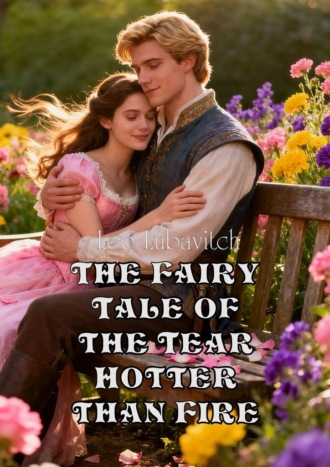
The Fairy Tale of the Tear Hotter than Fire

The Fairy Tale of the Tear Hotter than Fire
Leo Lubavitch
Illustrator leonardo.ai
© Leo Lubavitch, 2026
© leonardo.ai, illustrations, 2026
ISBN 978-5-0069-5132-7
Created with Ridero smart publishing system
Far, far away, where the North Wind sharpens its icy teeth against the cliffs, stood the castle of King Frederick. Oh, it was a magnificent castle! Its walls were hewn from granite, as gray and hard as the King’s own fist.
Inside, the castle was so quiet you could hear a spider spinning its web in the corner – though, truth be told, there were no spiders. King Frederick tolerated no living thing that failed to pay taxes. Servants walked on tiptoe, terrified of creaking a floorboard, for the floors were waxed so heavily one might slip and slide straight into the neighboring kingdom.
King Frederick himself, known as «The Iron,» loved numbers above all else. He loved them more than the scent of roses, more than a child’s smile, and certainly more than the foolish songs of a nightingale.
«A nightingale sings for free,» the King would say, frowning until his eyebrows looked like fuzzy caterpillars. «And what is free has no price. And what has no price is useless.»
He spent his days in the throne room, hung with heavy tapestries from Flanders. They depicted battles and feasts, but the threads were woven so tightly it seemed the people in the pictures had no air to breathe. Mirrors from Venice stood everywhere – enormous, in gold frames. But a strange thing happened: when the King looked into them, they reflected his crown, his velvet doublet embroidered with pearls, his signet rings… but never the happiness in his eyes. Perhaps because mirrors, as is well known, do not know how to lie.
The King would look out the window at his domain and see neither green meadows nor the silver river.
«This forest,» he would mutter, tracing a finger down a ledger, «is two hundred thousand ship masts. And this river – that is the fishing tax. And these mountains… hmph, a pity one cannot sell the snow that covers them!»

But in this cold castle, drawn as if by a ruler, there was one person who could not count at all. This was the King’s son, Prince Christian.
Christian resembled his father as much as a living wild rose resembles an iron nail. He felt suffocated amidst the velvet and mirrors. His collar, starched stiff by the court laundresses, pricked his neck, and his crown was forever slipping to one side because the Prince was constantly craning his head to watch the swallows fly by.
As soon as the King was distracted by recounting his gold coins (a pastime he loved more than dinner), Christian would quietly open the heavy oak door and flee. Where to? To a place that smelled not of wax and dust, but of resin and damp leaves. To the forest!
There, among the tall pines, he had true friends. Not dukes who bowed so low their noses touched their shoe buckles, but simple charcoal burners with faces black from soot, and old shepherds.
«Your Highness, you’ve soiled your cuffs again!» the court ladies would gasp upon his return.
«But I found a thrush’s nest!» Christian would reply, his eyes shining so brightly that the candles in the candelabras seemed like dim stubs. «And I helped the charcoal burner work the bellows. The fire sang a song for us!»
King Frederick looked at his son and only shook his head. His heart beat evenly and heavily, like coins falling into a chest.
«You behave not like a prince, but like a peasant,» he said in a voice that made flowers in vases wilt. «What use are your charcoal burners? They are poor. And poverty is a disease a king should be ashamed to catch.»
One evening, the King unfurled a huge map upon the table. It rustled like dry skin.
«Listen, Christian,» he said, and his finger, heavy with a signet ring, stabbed at a neighboring kingdom. «Enough running after squirrels. I have found a way to make our borders wider and our coffers heavier. You are to be married.»
«To whom, father?» asked Christian, and his heart clenched like a trapped bird.
«To the princess of the neighboring realm. They say she is wealthy. Her father possesses so much land that a bird must fly for three days just to cross it. Imagine the tax revenue! We will unite our lands, and I shall become the most powerful king of the North.»
«But is she kind?» the Prince asked softly. «Does she love the sound of the rain?»
«She loves gold,» the King snapped. «And that is what matters. A princess should be a costly setting for a kingdom, not a companion for listening to the rain. Prepare yourself. The ambassadors arrive tomorrow.»
Christian looked at his father, then at the cold mirrors reflecting the void, and he felt a sorrow as deep as if the sun had decided never to rise again. He understood that they intended to sell him, just as they sold timber for masts or sheep for wool. But surely a heart is not a coin; it cannot be slipped into a purse and the drawstring pulled tight. Or can it?
That night, the castle was especially cold, though the fireplaces were blazing. The chill radiated not from the stones, but from the King’s thoughts, for he was already calculating the dowry, having forgotten to ask his son if he wished to be miserable.
And so, Christian set off for the forest. For one had only to cross the castle threshold and venture into the thicket for the world to change. Here, trees did not stand at attention like soldiers on parade, but grew exactly as they pleased. Old oaks creaked, telling fairy tales to the young aspens, which trembled with delight in every leaf.

It was here, in a sun-dappled clearing where the wild strawberries were sweeter than royal confections, that Christian met her.
Her name was Stella. The name means «Star,» yet she did not shine with the cold brilliance of distant luminaries. Oh, no! She was warm and alive, like a sunbeam resting on one’s palm. Stella was the daughter of a simple forester. She wore no rustling silks, nor the heavy velvet that makes one faint in the heat. Her dress was sewn from coarse linen, but it smelled of meadow herbs and summer wind – which, you must agree, is far more pleasant than the smell of mothballs from royal chests.
Instead of a gold crown, which forever presses on the temples and gives kings headaches, living flowers were woven into her hair – modest forest bluebells and forget-me-nots.
«Look,» she said to the Prince at their first meeting, not at all frightened by his doublet. «Is your father truly richer than this little spider?»
Christian was astonished. He leaned in and saw a spiderweb strung between the branches of a hazel bush. Trembling on the thin threads were drops of morning dew. Each droplet reflected an entire sun, and they shimmered with all the colors of the rainbow – brighter than the diamonds in King Frederick’s crown.
«My father hoards his treasures in dark cellars,» the Prince said quietly. «But these hang in plain sight and will vanish by noon.»
«That is the wonder of it,» smiled Stella. «The beauty that cannot be possessed is the truest kind. You cannot put it in your pocket; you can only let it into your heart.»
Stella taught the Prince to listen. Before, he had heard only the clinking of coins and the scratching of court scribes’ quills. Now, he heard a chaffinch arguing with a brook, and an old spruce sighing before the rain. She showed him that the world is a vast musical box, which God wound up for the joy of everyone, be they prince or pauper.
And then, what always happens in good old tales – and in life, too – came to pass: their hearts reached out to one another like two stems toward the sun. They loved each other as purely and tenderly as only those who have not yet forgotten how to marvel can love.
But the love of a prince and a poor girl is a flower that is hard to shelter from the north wind.
One day, as the sun was setting, painting the pine trunks in an anxious crimson hue, Christian drew his hunting dagger. The blade flashed with cold steel.
«Stella!» he exclaimed with the fervor of youth. «I swear by this blade! Let my heart stop, let me turn to stone by the roadside, if I ever marry another! I need no princess with chests of gold. Only you, my forest star!»
He spoke hotly, and his eyes flashed lightning. But deep in his soul, in that place where our quietest fears hide, lived a small, cold draft. The Prince was afraid.
He feared not dragons nor bandits – one can fight them with a sword. He feared his father’s gaze. That same gaze the King used to look at figures in a ledger. Christian knew: for the King, love was merely a foolish invention, like the belief that flowers have souls.
Therefore, upon returning to the castle, the Prince hid his happiness deep in his pocket, like a stolen apple. He smiled at Stella in the forest, but grew pale and silent before his father. Ah, how often we humans are brave with words when holding the hand of our beloved, and how we quail when stern reality stares us down!
The dagger returned to its sheath, the vow hung in the air, and twilight thickened over the forest, concealing both the lovers and their secret. But secrets, my friend, have a habit of growing like shadows at sunset.
The day was fading. The sun, red and weary like a ripe apple, rolled over the edge of the earth, and the forest instantly changed.
Prince Christian and the forester’s daughter Stella had been talking so long about why grasshoppers have backward knees and what the leaves whisper about, that they had quite forgotten the time. And time in the forest is a tricky thing: by day it stretches like sweet honey, but by night it vanishes like a startled hare.
«We must go,» Stella said, and her voice trembled.
The forest, so welcoming just a moment ago, had suddenly turned alien. The old oaks, which by day seemed like kindly grandfathers, now scowled and creaked their joints. Roots that had surfaced from the earth looked like frozen snakes, and shadows stretched out to snatch at the travelers’ heels. Somewhere an owl hooted – a sound as dreadful as if someone had dropped an empty iron kettle down a deep well.
And suddenly, from the thickest shadow, right where a rotten stump bristled with toadstools, an old woman emerged.
Oh, how hideous she was! Her nose was hooked like a hawk’s beak, her back was bent as if she had spent a lifetime carrying a sack of sins, and her eyes burned like two embers in a cold stove. This was Morana, mistress of the fetid swamps. She leaned heavily on a cane of blackened bone.
Конец ознакомительного фрагмента.
Текст предоставлен ООО «Литрес».
Прочитайте эту книгу целиком, купив полную легальную версию на Литрес.
Безопасно оплатить книгу можно банковской картой Visa, MasterCard, Maestro, со счета мобильного телефона, с платежного терминала, в салоне МТС или Связной, через PayPal, WebMoney, Яндекс.Деньги, QIWI Кошелек, бонусными картами или другим удобным Вам способом.