Полная версия
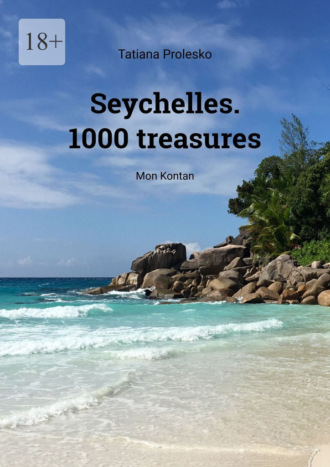
Seychelles. 1000 treasures. Mon Kontan

The Secrets of the Seychelles
There is a unique monument in the world called Twa Zwazo – “Three Birds.”
It symbolises unity between Europe, Africa, and Asia. Twa Zwazo stands in Victoria, the capital of a small island nation that offers a remarkable example of how friendly relations can be maintained with all the countries connected to its long and unusual history.
If one follows the map south from the Arabian Peninsula toward Madagascar, small islands can be spotted in the Indian Ocean – named after the French Minister of Finance Jean Moreau de Séchelles.
Solomon’s Nut
Long ago, ocean waves carried enormous, unusually shaped nuts to the shores of India, Ceylon, the Maldives, and even Malaysia. No one knew what they were – fruit or mineral? Where did they grow, and where did they come from?
This natural wonder was named “Solomon’s Nut” or “the sea coconut” and was believed to possess healing properties. Its value was extraordinary: rulers were willing to exchange an entire merchant ship for a single nut.
The Holy Roman Emperor Rudolf II dreamed of acquiring one, even considering paying for it with the ransom of a captured city.

Only in the mid-18th century were palm trees bearing these nuts discovered on the island of Praslin. The mystery of Coco de Mer was finally solved.
Early Traces
The earliest references to the Seychelles date back to 851 AD. An Arab navigator, carried by monsoon winds on a single-masted vessel, was diverted from India toward Africa. He named the islands Sea of Zanj, meaning “Sea of the Black People.”
In 916, the geographer Abu Zayd al-Hassan referred to mountainous islands in the Indian Ocean, located “far beyond the Maldives.” This description clearly evokes the image of granite islands rising on the horizon.
The Arabs called them Zarin – “The Sisters.”
Treasure Islands
Much later, Vasco da Gama passed the Seychelles in 1502, and the first documented European visit dates to 1609. Portuguese maps from 1544 refer to the islands as “The Seven Sisters.”
The islands Petite Soeur and Grande Soeur still carry these names today.
For many years, the Seychelles served as a refuge for pirates. Among the most famous were Olivier Levasseur in the early 17th century and Jean-François Hodoul at the turn of the 18th and 19th centuries.
The archipelago offered ideal conditions: isolation, an absence of permanent settlements, numerous sheltered bays, a warm climate, fresh water sources, abundant food, and timber for ship repairs. All of this drew pirates like a magnet.
After a daring attack on a ship carrying the Viceroy of India and a treasury, the French and British decided to cooperate in order to suppress piracy in the region.
The First Settlements
The French became the first permanent settlers on the Seychelles.
In 1756, an expedition led by Corneille-Nicolas Morphey arrived with the aim of formally claiming the islands for France.
On 1 November, the French flag was raised on Mahé, and two years later the islands were officially named in honour of Jean Moreau de Séchelles.

The “Father of the Seychelles”
The late 18th and early 19th centuries are closely associated with Governor Quéau de Quincy, who is still referred to as “the father of the Seychelles.”
At the time, Britain and France were at war. In 1794, British ships approached Mahé. With limited forces at his disposal, de Quincy assessed the situation and chose to surrender, avoiding bloodshed.
For the next seventeen years, depending on which warships entered the port, either the British or French flag would be raised – and lowered again once the ships departed.
Through this pragmatic approach, Mahé alternated between British and French control, while major conflicts were avoided.
In 1814, together with Mauritius, the Seychelles became British possessions. It was then that the letter “y” appeared in the country’s name – previously spelled Sechelles.

Between 1861 and 1874, approximately 3,000 formerly enslaved people, rescued by the British from Arab slave ships, were brought to the Seychelles and became new residents of the archipelago.
In 1897, the islands were administratively separated from Britain and became a colony of the British Crown.
Towards Independence
The First World War caused significant economic damage to the Seychelles, and recovery was slow, with improvement beginning only around 1936.
After the Second World War, British authorities increasingly considered granting independence to African colonies in order to reduce the financial burden of overseas administration.
Agreement was reached only in January 1976, following negotiations that included financial support from the United Kingdom during the early years of independence.
On 29 June 1976, the Republic of Seychelles was officially proclaimed.

Cold War Crossroads
During this period, the Indian Ocean region also attracted the attention of the Soviet Union, which sought strategic presence in East Africa. Closer relations became possible after France-Albert René came to power in 1977, replacing the pro-British leader James Mancham.
In the autumn of 1977, a Soviet naval vessel visited the Seychelles – the first such visit in the country’s history.
In 1984, a Soviet delegation led by Rear Admiral Mikhail Abramov arrived, and agreements were reached regarding port access and aircraft landings. At the same time, it was diplomatically emphasised that Seychelles maintained strong ties with Western Europe and the United States, and these arrangements were kept discreet.
The Soviet Union provided financial and military assistance, including training for Seychellois forces.
Later, military advisers from various countries – including Tanzania, North Korea, the United Kingdom, Portugal, and the United States – were also involved in training and cooperation.
Through careful diplomacy, the Seychelles succeeded in maintaining constructive relations with all major world powers.
A Place of Balance
The islands’ unique beauty – their colours, energy, warm and safe ocean, and even the air itself – creates a deep sense of calm and joy.
Perhaps this is the secret behind the Seychelles’ ability to serve as a model of diplomatic balance in a complex global history.
It is simply very difficult to remain in a bad mood here – at least for more than a minute.


Kaleidoscope of islands
The inner islands
The Inner Islands – the main ones being Mahé, Praslin, and La Digue – form the cultural and economic heart of the Seychelles and remain the most popular with visitors.
Mahé
Mahé is the largest island of the archipelago. It is home to the international airport and to Victoria, the capital of the country. The government sits here, and it is the main centre of trade. Around 90% of the population lives on Mahé.
Mahé has a thousand mountain peaks, and its flora is a true treasure: endemic plants found nowhere else in the world.
Many excursions start from Mahé, yet the island itself has an abundance of attractions and beaches.
Praslin
Praslin is sometimes affectionately called Praslé, in the French manner. It is the second-largest island of the Seychelles, located 45 km southeast of Mahé.
It is known worldwide for the Vallée de Mai, a UNESCO reserve – the only prehistoric forest preserved on the planet.
In the mid-19th century, the island’s northern coast – Côte d’Or – was a favourite area for pirates. The island was named after the Duc de Praslin, France’s Minister of the Navy, in 1768, when the Stone of Possession was placed on Anse Possession beach as a formal marker of ownership.
A century and a half later, scientists put forward a hypothesis that the Vallée de Mai may be the location of the Garden of Eden, where Adam and Eve lived.
This untouched forest is home to the famous Coco de Mer palm, which bears the world’s largest nuts – striking in both size and shape – as well as several other palm species found only in the Seychelles.

La Digue
La Digue is the fourth-largest island, a neighbour of Praslin and also of Félicité, Marianne, and the Sisters. Its name comes from one of the ships of a French expedition that arrived to study the granitic islands in 1768.
La Digue is home to the Seychelles Paradise Flycatcher – one of the rarest birds in the world – as well as two unique species of tortoises and other representatives of local fauna.
In the island’s forests you will find many orchids, vanilla vines, Indian almond trees, takamaka, hibiscus, and coconut palms.
This is an island where time seems to slow down. The tradition of cycling remains strong, and ox-drawn carts can still be seen. Traditional boat-building methods and the processing of coconut products are still practised here.
Visitors remember the exceptionally friendly atmosphere of this unique island, the L’Union Estate reserve, and beaches ideally suited to snorkelling and diving – including the legendary Anse Source d’Argent.


Bird Island
The northernmost island of the archipelago is about a 30-minute flight from Mahé. Once, Bird Island was called Cow Island, because dugongs – “sea cows” – lived there.
Thousands of rare birds consider this island home, and whales can sometimes be spotted nearby.
Bird Island is also home to Esmeralda, the world’s largest tortoise, weighing up to 300 kilograms and living for over 200 years.
Tourism began to develop here in the early 1970s, and since then great importance has been placed on environmental protection.
In addition to birdlife, guests will find an eco-hotel made up of 24 unusual bungalows, beautiful beaches, excellent food, a warm atmosphere, and strong opportunities for snorkelling, fishing, and quiet contemplation of nature.
Cerf Island
Cerf, Mahé’s closest neighbour (only 4 km away), lies within the Sainte Anne Marine National Park and offers excellent conditions for swimming and snorkelling.
It is a wonderful place to sunbathe, picnic, and wander along small trails – Cerf has no paved pedestrian roads.
The island took its name from a frigate that arrived in 1756 as part of an expedition intended to claim the Seychelles for France. Traces of a once-developed coconut-growing industry can still be seen in its lush groves.
Cerf is home to exotic shrubs, giant tortoises, and fruit bats. There are several hotels and private villas on the island.

Morning on Cerf Island
Chauve Souris
A small island located a few hundred metres from Côte d’Or beach on Praslin. At low tide, it can be reached on foot through shallow water.
Its name comes from the fruit bat species found here; in the past it was also known as Jeanette Island.
Due to its formation, granite rocks dominate the landscape. The flora consists largely of ornamental plants and shrubs. The fauna includes skinks, geckos, and some bird species.
There is a small hotel here with only six rooms, built around the rocks.

Mysterious Chauve Souris
Cousine
Located 6 km off the western coast of Praslin, Cousine is a unique island where complete seclusion is possible. There are very few places like it in the world: a nature reserve, home to endemic birds and giant tortoises, rich in distinctive fauna and marine life.
Once a coconut plantation, Cousine is now home to a luxury resort with five villas built in a colonial style.

A first meeting on Cousine
Denis Island
Situated 95 km north of Mahé and 45 km east of Bird Island, Denis is one of the northernmost islands of the archipelago.
Like many islands, Denis was once a plantation, with a population of 70—100 people. In 1975, it was bought by a French magnate, Pierre Burkhart, who turned Denis into an immensely popular resort under the slogan “an island at the edge of the world.” In the mid-1990s, Denis was sold to the first tour operator to appear in the Seychelles.
Denis has exceptionally lush vegetation and is home to many seabirds and land birds.

It is a paradise for both beginner and experienced anglers: marlin, barracuda, dorado, tuna, and wahoo can be found here.
Denis offers walks along trails, tennis, diving, and windsurfing – and, of course, sunbathing and swimming on dazzling white beaches, while staying in a five-star deluxe resort made up of 22 chalets, denying yourself nothing.

Fregate
Fregate is the most distant granitic island from Mahé. The name is associated with a well-known pirate who appears in 17th-century history.
The island once served as a refuge for pirates who hid stolen treasures there.

After the Second World War, a Seychellois magnate bought the island and turned it into a place where vegetables, fruit, coffee, vanilla, cinnamon, and poultry were produced for sale in Mahé’s markets. At that time, around 100 people lived on Fregate.

The island is home to more than 50 species of rare birds, as well as giant tortoises. Today, its famous hotel – among the finest not only in the Seychelles but in the world – is a favourite holiday destination for many celebrities.
North Island
Located a few kilometres from Silhouette, North is the smaller of the two islands visible from Beau Vallon beach.
North was among the islands sighted in 1609 during Captain Alexander Sharpeigh’s expedition. With some of the most fertile soil in the Seychelles, North was once settled by people growing vegetables, working coconut plantations, and engaged in fishing.
In 2003, a resort of 11 villas opened here. Today, North is considered the most expensive place to stay in the Seychelles.
Round Island (near Praslin)
This island lies on a coral reef at the entrance to Baie Sainte Anne. Visitors are welcomed by a lagoon ideal for snorkelling.
The diving here is particularly rewarding, revealing the diversity of marine life. Until 2015, there was a private resort on the island; it is not currently operating.

Silhouette
The third-largest island of the archipelago lies 30 km from Mahé, near North Island. It is the island most clearly seen from Beau Vallon, often with a small cloud resting above its mountain peak.
It is likely that Arabs used Silhouette as a base as early as the 9th century – ruins of Arab graves at Anse Lascars suggest this. Silhouette was among the first islands recorded during Sharpeigh’s expedition in 1609, yet the first permanent settlement appeared only in the early 19th century.
The island is under nature protection in the Seychelles and can be thought of as a living museum of natural heritage, home to unique plants.
Silhouette’s highest point is Mont Dauban, at 731 metres. The island’s pristine beauty and history draw visitors who wish to explore the legends of the pirate Hodoul, said to have hidden treasures here.
Silhouette is home to the five-star resort, built on the site of the island’s first hotel, which had only 12 rooms, as well as a stylish lodge and a National Geographic station.
Sainte Anne
The largest island in the Sainte Anne Marine National Park lies just 4 km off Mahé’s eastern coast, near Cerf, Round, Moyenne, Long, and Ile Cachée.

Discovered in 1742 by the well-known explorer Lazare Picault, Sainte Anne was the first island where the French landed before settling on Mahé.
Félicité
Located 4 km from La Digue, near the Sisters, Marianne, and Île Coco, Félicité is a picturesque granitic island.
Until the 1970s it was a coconut plantation with a population of about 50 people. In the 19th century, the Sultan of Perak is said to have spent five years on Félicité before returning to Mahé.

Today, a five-star resort operates here.

Grand Anse Beach, Félicité
Moyenne
Moyenne lies just 6 km from Mahé, near Round, Long, Sainte Anne, and Cerf. Once a pirate refuge, the island remains wrapped in tales of ghosts guarding treasures hidden here.
The island first belonged to an English lady. From 1915 to 1970, it lay abandoned, until it was purchased by Brendon Grimshaw, an editor of an English newspaper. He turned Moyenne into a tropical paradise, living here in the spirit of Robinson Crusoe.
The island offers excellent conditions for swimming, snorkelling, and hiking. It can be walked around in an hour, though a deeper exploration can easily take a full day.

Pirate bay on Moyenne
Round Island (near Mahé)
A neighbour of Moyenne within the Sainte Anne marine reserve. Round Island offers beautiful beaches and coves, and a leisurely walk around it takes about 15 minutes.
Today, a charming boutique resort operates here in a colonial style, with each villa having private access to the beach.

A good day with a view of Round Island
The Outer Islands
Aldabra
“Another planet” – this is often the first impression shared by those fortunate enough to visit.
The atoll lies 1,150 km southwest of Mahé. It is the largest coral atoll in the world, consisting of more than twelve islands encircling a lagoon whose size exceeds the entire perimeter of Mahé.
Aldabra is a UNESCO World Heritage Site. It is home to unique flora and fauna, including the world’s largest population of giant tortoises – approximately 150,000 individuals. The atoll’s lagoon hosts virtually all marine species found across the Seychelles archipelago.
The atoll takes its name from an Arab navigator. In 1874, a small settlement existed here, where residents were engaged in fishing and the production of copra.
Today, expeditions to Aldabra are organised under strict limits, with visitor numbers carefully controlled in order to preserve its fragile ecosystem.
Astove Atoll
Astove lies 1,045 km from Mahé and 160 km southwest of Aldabra, making it one of the southernmost islands of the Seychelles archipelago.
The atoll is surrounded by a coral reef, and its lagoon is shallow. Conditions here are exceptional for experienced divers.
Cosmoledo Atoll
Cosmoledo is one of the main islands surrounding the lagoon.
Its waters are especially rich in marine life. Green turtles are commonly found here, while the skies are filled with birdlife – including frigatebirds, terns, and cormorants.
A lodge has been built here in recent years, making it possible for visitors to stay on the atoll.
Desroches
Among the islands of the Amirantes group, Desroches lies closest to Mahé – approximately 230 km southwest.
Visitors are welcomed by 14 kilometres of beautiful beaches, lush coconut groves interspersed with casuarina trees, and a luxury hotel.
Desroches was named after a French governor of Mauritius. The flight from Mahé takes about 40 minutes.

On Desroches Island, 2015