Полная версия
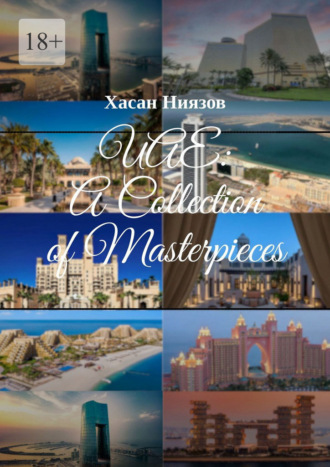
UAE: A Collection of Masterpieces

UAE: A Collection of Masterpieces
Хасан Ниязов
© Хасан Ниязов, 2026
ISBN 978-5-0069-2610-3
Created with Ridero smart publishing system
Chapter 1. BURJ AL ARAB
The Hotel That Became a Symbol of Human Audacity
When You See It for the First Time
You do not simply enter the Burj Al Arab.
You approach it.
The road curves gently to the right, and before you appears a silhouette that resembles no other building on Earth. White, curved, like a taut sail, it stands upon an artificial island in the Arabian Gulf – separate from everything, as if to say:
“I am not part of the city. The city is part of me.”
Even if you have seen it in photographs a thousand times, in person, it strikes you harder.
Dubai has many skyscrapers.
Many expensive hotels.
Many buildings that scream of money.
But the Burj Al Arab does not scream.
It stands calmly – like a king who knows he has no need to prove his superiority.
How It Came to Be
In the 1990s, Dubai was wealthy, yet not legendary.
Sheikh Mohammed bin Rashid Al Maktoum wanted the emirate to possess a symbol that would be recognised in any corner of the world – like the Eiffel Tower for Paris or the Statue of Liberty for New York.
He told the architects a simple thing:
“Do not build me a hotel. Build me an icon.”
The project was entrusted to the British architect Tom Wright.
And he created a masterpiece of madness – a hotel in the shape of the sail of an Arabian dhow, standing on its own island, 280 metres from the shore.
To achieve this, they first created the island.
Millions of tonnes of rock and sand were poured into the sea.
Then, they reinforced it with piles so the building would not sink beneath the water.
This was not merely an engineering project.
It was a challenge to the ocean.
Architecture That Should Not Have Worked
The Burj Al Arab is unlike ordinary buildings.
It has no standard floors.
Inside lies a colossal atrium, 180 metres high, the tallest in the world.
When you enter, it feels as though you are inside a cathedral.
But instead of stained glass – there is gold, glass, and light.
The interior utilises:
– Over 8,000 m² of 24-carat gold
– Marble from Italy and Brazil
– Handmade carpets
– Lifts with panoramic views of the ocean
This is not minimalism.
This is demonstrative luxury.
The Burj Al Arab was built to show the world:
“We can do anything.”
Why It Is Called 7-Star
Officially, 7-star hotels do not exist.
The maximum is 5.
But the Burj Al Arab transcended this classification long ago.
Here:
– Every suite has a personal butler 24/7
– Transfers are conducted via Rolls-Royce or helicopter
– All rooms are suites (starting from 170 m²)
There are no standard rooms.
Only luxurious apartments.
The First Step Inside
You step out of the car.
The door is opened by a person in a perfectly pressed uniform.
He does not say “hello”.
He looks you in the eye and smiles as if he had been waiting specifically for you.
Inside – the air smells not of perfume, but of cleanliness and money.
The silence is thick, like velvet.
Every step on the carpet sounds different.
You feel that this is not just a hotel.
It is a performance, where you are now one of the actors.
Inside the Suites: What Life Looks Like Behind Golden Doors
When the lift doors close, you are no longer in Dubai.
You are in a world where reality submits to money.
The lift rises silently.
No familiar hum.
No vibrations.
Only soft light and the sensation that you are ascending not upwards, but to another level of existence.
The doors open.
And you enter the suite.
The First Sensation
The first thing you feel is space.
The Burj Al Arab does not do narrow corridors or small rooms.
Here, even the entrance is a hall the size of a standard flat.
Before you:
– A staircase with a handmade carpet
– Columns
– Huge floor-to-ceiling windows
– And the ocean, which seems to hang in the air
This is not a room.
These are the apartments of a person who does not ask the price.
Duplex Life
All suites here are two-storey.
On the first level:
– A living room with sofas you can drown in
– A study
– A dining area
– A bar
– Panoramic windows overlooking the Arabian Gulf
On the second level:
– A bedroom
– A bathroom with a jacuzzi
– A dressing room
– A separate relaxation area
You literally live in two worlds:
Day – in the light of the ocean.
Night – in the soft gold of the interiors.
Gold Everywhere
Gold here is not an accent.
It is the background.
Door handles.
Mirror frames.
Furniture elements.
Even the buttons on the remote controls are gold-plated.
This is not screaming luxury.
It is a demonstration:
“We can afford to spend gold on things others spend plastic on.”
Technology Inside the Suite
Every suite is equipped with:
– A “smart home” system
– Touch control panels
– A personal iPad
– High-speed internet
– A multimedia system
You can:
– Order food
– Summon the butler
– Adjust the lights, music, curtains
– Even choose the scent of the room
With a single touch.
The Butler
You have a personal butler.
Not on request.
He is assigned to you.
This is a person who knows:
– How you take your coffee
– What water temperature you prefer
– When you wake up
– And what you dislike
If you say:
“I am cold.”
Within a minute, a blanket will be brought to the room.
If you say:
“I want cake.”
It will appear.
If you say nothing —
he will sense it anyway.
The Bathroom
The bathroom here is not a place for hygiene.
It is a ritual.
Marble.
Gold.
A jacuzzi overlooking the ocean.
A separate shower.
A set of elite Hermès cosmetics.
You sit in the water, look at the sea, and realise:
In ordinary hotels, you wash.
Here – you live.
How the Night Feels
When the sun departs, the Burj Al Arab becomes something else.
The city lights up.
The ocean darkens.
Inside the suite, soft lighting engages.
You sit on the sofa, look at the lights of Dubai, and realise:
You are above the city.
You are not a tourist.
You are part of this world’s elite.
Even if only for one night.
Who Lives in the Burj Al Arab
One does not arrive at the Burj Al Arab by accident.
People who look for “good value for money” do not stay here.
One does not come here for discounts.
One does not book a room “simply because the beach is nearby”.
Those who come to the Burj Al Arab want to be above the world.
Typical Guests of the Burj Al Arab
1. Billionaires and Business Empire Owners
For these people, the Burj Al Arab is not a luxury.
It is a convenience.
Here:
– High level of security
– Confidentiality
– Personalised service
– No one asks unnecessary questions
Many come here for:
– Deals
– Secret negotiations
– Meetings with partners
The Burj Al Arab is not just a hotel.
It is neutral territory for global money.
2. Stars and Global Celebrities
Guests have included:
– Hollywood actors
– Pop stars
– Top models
– Athletes
– Members of royal families
But most importantly – they are not photographed here without permission.
The hotel knows how to keep secrets.
Celebrities love the Burj Al Arab because:
– You can go to the beach and remain unnoticed
– The staff do not tell tales
– Security works invisibly
3. The Arab Elite
For wealthy families from Saudi Arabia, Kuwait, and Qatar, the Burj Al Arab is almost like a second home.
They arrive:
– With children
– With security
– With drivers
– With personal chefs
And the hotel adapts to them.
Sometimes, a single family with their staff occupies an entire suite.
For them, it is not a room – it is a temporary palace.
4. People Celebrating Life
There is a special category of guests.
These are people celebrating:
– A wedding
– A honeymoon
– An anniversary
– A divorce
– A major deal
– The start of a new life
They do not come here for practicality.
They come for the feeling that this moment is the most important in their life.
How Guests Behave
Interestingly, in the Burj Al Arab, people do not behave like tourists.
There is no fuss.
No noise.
No running around with cameras.
Everyone behaves as if:
“I am here because I am meant to be here.”
Even those who have arrived for the first time.
Quiet Luxury
In the Burj Al Arab, there are no ostentatious logos.
Brands do not scream here.
The level screams.
The watches on the guests’ wrists cost as much as houses.
Handbags – as much as cars.
Jewellery – as much as small countries.
But no one stares at anyone else.
Because here, everyone is equally outside of ordinary reality.
What You Feel Beside Them
When you are amongst these people, you sense a strange thing:
You realise that for them, the world works differently.
For them:
– Planes are taxis
– Countries are neighbourhoods
– Money is a tool, not a goal
And the Burj Al Arab is their drawing room.
Restaurants Where Dining Is a Performance
In the Burj Al Arab, food is not about hunger.
It is about the feeling that you are living in a film.
One does not “go to eat” here.
One goes to live through an evening.
Every restaurant is a stage.
Every dinner is a performance.
You are not just a guest – you are part of the production.
Al Muntaha – The Restaurant in the Sky
It is located 200 metres above the sea.
Its name translates as “The Ultimate” – and this is not marketing.
You step into a lift that whisks you upwards along the building’s façade.
Through the glass, you see the ocean and Dubai become toy-like.
When the doors open, you enter a hall where:
– The walls are glass
– The ceiling is light
– The city is beneath your feet
Here they serve:
– French cuisine
– Seafood dishes
– Tasting menus from world-class chefs
You sit with a glass of wine, looking at the lights of Dubai, and realise:
People below are living.
You – are soaring.
Al Mahara – The Underwater Restaurant
This is the Burj Al Arab’s most famous restaurant.
You enter a tunnel.
The light turns blue.
And suddenly, before you – a massive aquarium.
You sit at a table, and beside you:
– Sharks swim
– Rays
– Tropical fish
You eat lobster while a shark glides past.
This is not a zoo.
It is the sensation that you are dining inside the ocean.
Here they serve:
– The freshest seafood
– Oysters
– Caviar
– Signature dishes from the chefs
It is not cheap.
But you are not paying for food.
You are paying for an impossible experience.
Skyview Bar – Cocktails Above the World
This bar is at the same height as Al Muntaha, but the feeling is different.
Here:
– Subdued lighting
– Sofas
– Live music
– People in evening wear
You sit, drinking a cocktail, looking at a city burning with thousands of lights.
This is a place where:
– Deals are struck
– Romances begin
– People feel beautiful
Junsui – Japan in the Heart of Dubai
This restaurant is an entire gastronomic world.
Here:
– Sushi
– Teppanyaki
– Asian cuisine
– Live cooking stations
You can:
– Watch the chef slice the fish
– Watch the fire burn
– Watch the food being created
This is not just a restaurant.
It is gastronomic theatre.
How You Are Served
Waiters do not simply serve dishes.
They know:
– What you love
– What you ate yesterday
– What you cannot tolerate
The plate is not placed on the table – it appears.
Wine is not poured on request – but at the precise moment.
Here, they do not ask you:
“Did you enjoy everything?”
Because here, everything must be perfect by default.
The Feeling of Dinner at the Burj Al Arab
You do not leave the restaurant full.
You leave changed.
Because you didn’t just eat.
You lived an evening in a world where everything is created to make you feel chosen.
The Cost of Living in a Legend
The Burj Al Arab is not a hotel where one asks the price.
It is a place where the price is accepted as a given.
One does not buy a night’s stay here.
One buys status, emotion, and the feeling that you have stepped beyond the bounds of the ordinary world.
How Much a Room Costs
The simplest suite in the Burj Al Arab is around 170 square metres.
Price:
– From $1,500—2,000 per night in the quietest periods
– Up to $10,000—25,000 per night in high season or for superior suites
Royal apartments can cost $30,000—40,000 per night.
This is not a mistake.
This is reality.
What Is Included in This Price
You are not paying for a bed.
You are paying for:
– A personal butler
– Privacy
– Security
– The level of service
– Access to restricted areas
– Status
You can order:
– A helicopter
– A yacht
– A personal chef
– A shopping concierge
– Security detail
And no one will say “no”.
How Much Dinner Costs
Dinner in the Burj Al Arab’s restaurants:
– From $200—300 per person
– Up to $1,000+ for a tasting menu with wine
But you are not paying for food.
You are paying for:
– The view
– The atmosphere
– The silence
– The people around you
What You Are Really Paying For
The Burj Al Arab does not sell luxury.
It sells the feeling of exclusivity.
You pay so that:
– No one stands next to you in a queue
– No one disturbs you
– Everything is tailored to you
You pay for the world to slow down.
Who This Hotel Suits
It suits:
– People with substantial money
– Those who want maximum comfort
– Those who value privacy
– Those celebrating an important moment in life
It does not suit:
– Those looking for a “good deal”
– Those who love simplicity
– Those who dislike luxury
– Those who do not want to be the centre of attention
The Burj Al Arab is not about rest.
It is about asserting oneself.
The Final Sensation
When you check out of the Burj Al Arab, the city seems different.
It seems:
– Noisy
– Fast
– Ordinary
And you realise:
You have been in a place where the world bends to the will of the individual.
Construction, Cost, Famous Guests and Reviews
– What the Legend of the Burj Al Arab Conceals
The Burj Al Arab in Dubai is not just a hotel.
It is an architectural symbol, a city landmark, the investment project of the century, and a legend of luxury known across the world.
Construction: How the World’s Most Expensive Hotel Was Created
The idea of creating a symbol-hotel was born in the early 1990s. The Sheikh of Dubai set a task: to build not merely a hotel, but an architectural beacon that would become the emirate’s calling card, like the Eiffel Tower for Paris.
The architectural design was developed by the British architect Tom Wright with the support of the international firm Atkins (UK). The task was for the building to resemble the sail of a traditional Arab dhow vessel, reflecting the region’s maritime heritage.
The most difficult part was not building the hotel, but placing it in the middle of the sea.
To do this:
– An artificial island was created off the coast, approximately 280m from the shore.
– 230 concrete piles, up to 40m long, were driven into the island to ensure stability and protection against erosion.
– The construction of the island took up to 3 years, while the hotel itself was erected in under three years.
In total, up to 2,000—3,500 construction workers participated in the project simultaneously, and more than 3,000 companies and designers worked on its engineering, architectural, and decorative solutions.
How Much the Project Cost
There is no exact official cost – the UAE government and Jumeirah Group have never disclosed it.
However, expert estimates suggest that construction cost approximately $1 billion – making the Burj Al Arab one of the most expensive hotels in history.
Of this sum:
– About 2 years went into creating the island,
– The remaining 3 years – on building the structure itself,
– Significant funds were spent on finishing materials, including tonnes of marble, rare woods, and gold leaf particles in the interiors.