



Полная версия
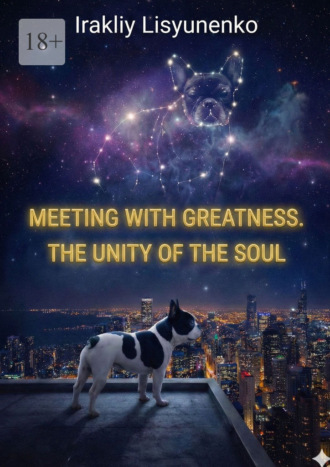
Meeting with Greatness. The Unity of the Soul

Meeting with Greatness. The Unity of the Soul
Irakliy Lisyunenko
© Irakliy Lisyunenko, 2026
ISBN 978-5-0069-2183-2
Created with Ridero smart publishing system
INTRODUCTION
Into the Wind
This book was not planned. It was not born in the cozy quiet of a writer’s study, amidst the aroma of coffee and leisurely reflections on high matters. It burst into my life on a gust of gale-force wind on March 16, 2020—the very day my life split into “before” and “after.”
That day, I lost the one I loved more than anyone in the world: my bulldog, Zi. To some, he was “just a dog.” To me, he was a son, a teacher, and a guide.
When he left, I was left standing on the ruins of my own heart. I was filled with pain, anger, and questions for Heaven. I looked for someone to blame. I sought justice. I wanted to find a magical weapon to punish the evil that, as it seemed to me, had invaded my world.
But instead of a weapon, I was given a Ladder.
This book is the chronicle of an ascent. It is an honest account of how a man, trying to outrun pain, found God.
My path ran through the night streets of Tbilisi and the sun-drenched beaches of Eilat, through the ancient texts of the Avesta and the mysteries of the Zohar, through the white interior of a Jaguar and the silence of a synagogue. I met teachers where I least expected them: in a Persian sage communicating via email; in a former cancer patient rescuing dogs; in a young man behind a Judaica counter; and, of course, in a black panther named Sarah, who came to teach me how to love again.
I wrote this book not as a guru who has grasped the Truth, but as a traveler who has worn his feet to the bone yet still found his way to the Light.
There is no fiction here. Every tear, every miracle, every coincidence of dates and names is real. This is a story about how to unite two great traditions – the wisdom of Zoroastrianism and the depth of Judaism – within a single human soul.
It is a story about how to turn Fear into a Navigator. It is a story about a Meeting with Greatness and finding the Unity of the Soul.
If you are holding this book in your hands, it means you, too, are searching. Perhaps you have lost your footing. Perhaps you want to understand if there is meaning in the chaos of life.
I invite you to walk this path with me. From the shattered vessel to the Planet of Elohim.
Welcome home.
PART I. LOSS AND THE SIGN
Here the old world collapses, and the first shoots of the new one appear.
CHAPTER 1. FAREWELL TO ZI
The world will remember 2020 as the year the planet pressed pause. News feeds were speckled with headlines about the virus, borders slammed shut with the clang of falling iron curtains, and people panic-bought buckwheat, locking themselves in their concrete cells. A sticky, electric fear of an invisible enemy hung in the air. The streets of Moscow emptied, resembling the set of a post-apocalyptic film.
But for me, the true end of the world did not arrive in WHO reports or on television screens. My personal apocalypse unfolded in the silence of my apartment, to the heavy, rhythmic sound of the breathing of the one who was dearer to me than most people. For the world, it was the beginning of a great calamity; for me, it was the finale of a long, exhausting war.
His name was Zorro. Or simply Zi.
If you have never loved a bulldog, it will be hard for you to understand the nature of this bond. This is not just a dog that wags its tail at the sight of a leash. A bulldog is a personality encased in a powerful, stocky body. In his heavy gait, his broad chest, in the way he grunted as he settled at my feet, there was something fundamental. Something ancient.
To say “pet” is to insult our connection. To say “favorite” is to reduce everything to the level of a toy. Zi was my son. My silent companion, the witness to my rises and falls. We had our own language – a language of glances, sighs, and touch. When he rested his heavy head on my knee, looking up at me with his dark, all-understanding eyes, I felt it: I was accepted. Completely. Without conditions.
His name was no accident. He bore it by right of birth. Zi was black and white, like an old film, but nature-the-artist had placed accents on him with mystical precision. There were exactly seven black spots on his body – the number of fullness and mystery. And on his face lay a perfect black “mask,” which is why he became Zorro. A hero in a mask, come to save my world.
His coat was velvet to the touch. When I buried my face in it, I sensed a scent impossible to confuse with anything else. It was not the smell of “dog.” Zi smelled of warm milk. It always seemed to me that he smelled not simply of earthly milk, but of starlight – as if he had just returned from a walk along the Milky Way, carrying the fragrance of galaxies on his fur.
He loved this world with a fierce, almost reckless passion. I remember our car rides. For most dogs, a car is merely a transport to a park or a vet. For Zi, it was a cinema. He would sit by the window, propping his paws on the door, and watch. He especially loved the evening city. The streetlights, the bustle of people, the flickering shop windows – he absorbed it all with the air of a philosopher. There was no predatory interest in his gaze, only pure contemplation. It seemed he understood something about this city that even I did not.
He came into my life thanks to Lena – a woman who became, perhaps, the brightest flash of love in my destiny. It was she who found this miracle. I remember him as a tiny, four-month-old puppy. I remember how he first saw himself in the mirror: funny, clumsy, barking at his reflection, trying to goad “that guy” into playing.
At home, he had his own “sworn enemy” and his own ritual game – the vacuum cleaner. As a joke in his childhood, I once “suctioned” him lightly with the hose, and from then on, cleaning turned into a ceremony. It was war and a game of tag all at once. Zi attacked the roaring monster, defending his territory, growled, jumped back, and attacked again. There was so much life in it, so much energy, that it seemed this battery would never run out.
Zi was the guardian of our hearth. When passions flared between Lena and me, when human Ego clouded our eyes and we began to scream, trying to prove we were right, Zi never hid. He threw himself into the epicenter of the storm. I remember our bedroom, the air electrified with conflict. Zi jumped with his front paws first on me, then on Lena, barking loudly, drowning out our cries.
“Stop!” he seemed to say. “Look at each other! You are destroying something more important than your foolish righteousness! You are destroying love!”
He was a peacemaker trying to glue our reality together with his black-and-white body. But we were poor students, too busy with ourselves. In the end, Lena and I parted ways, destroying what Zi had tried so hard to protect. Lena left, and Zi stayed with me – a living reminder of that love.
And then trouble came. It had a short, dry medical name: oncology.
Cancer entered his body long before 2020. It was a long siege. But Zi held on. He was a true fighter; he loved life too much to surrender without a battle. Chemotherapy began, then pills. I hid the bitter tablets in pieces of cheese – his favorite treat. He took them trustingly, swallowing them along with hope. At first, the only thing that betrayed the illness was his appetite. It began to fade, though even in this Zi remained true to himself: he never had greedy canine voracity; he always ate with the dignity of an aristocrat.
By March 2020, the disease had finally taken the upper hand. The last days became the most terrible trial – not physically, but mentally. Zi began to get lost. That wise philosopher who gazed at evening Moscow suddenly vanished.
I remember the moment that broke my heart. Zi was suddenly afraid of me. He did not recognize his “dad.” He ran into the bathroom, crawled under the sink into the deepest darkness, and froze there. I followed, sat on the cold tiles, and looked under the sink. The eyes of a stranger looked back at me. There was no recognition, only a mute question and fear. He did not want to come out, refused to come into my arms.
It was a strange, eerie feeling – to see the body of your beloved son but find no familiar contact within it. But now I understand it differently. Before completely disconnecting from physical life, God returned him to a state of absolute purity. He became a child. He forgot pain, he forgot attachments. His memory was cleansed before the Great Transition.
March 16, 2020. This date is branded into my memory.
The day began deceptively bright. Outside the window stood a sunny spring day promising life, but inside our apartment, time was running out. The finale unfolded in the living room, in the narrow space between the TV wall and the sofa. Zi lay there.
I sat beside him on the floor. I held his paw. It was the only thing I could do – to be an anchor, to hold his connection to this world until the very last second, so he wouldn’t be afraid. His body trembled. His eyes rolled back, fixing on something upward, somewhere I could no longer see him. He was releasing his spirit. The heavy, raspy breaths became rarer and rarer until silence fell.
At the exact moment he took his last breath, reality shuddered. The sun that had just flooded the room vanished. Not smoothly, as at sunset, but instantly, as if someone had flipped a switch. The sky outside the window filled with leaden greyness.
I was still holding his paw. Now it was just a paw, part of a shell. Zi was gone. I leaned down and kissed his forehead, saying goodbye to that “scent of the Milky Way” I loved so much. Then I stood up and wandered into the kitchen.
Mom was standing there. I needed to say the words out loud, to make death real.
“Zi is gone,” I said.
She froze and lowered her eyes.
“That’s it then,” she replied quietly.
There was so much humility before inevitability in those words. The period had been placed. But Heaven decided to put an exclamation mark.
The very second her words were spoken, the blackened sky outside exploded into motion. A wind that came from nowhere slammed into the kitchen window with such fury it seemed it would shatter the glass. It was a physical blow, dense and powerful.
On the windowsill stood a massive microwave oven. Heavy, at least ten kilograms. An object you don’t move by accident. But from the blow of the wind against the glass, from the vibration that pierced the house, it soared into the air. The heavy appliance flew off the sill like a feather caught in a hurricane and crashed to the floor with a thunderous noise.
Mom and I looked at each other. If I had read this in a book, I would have considered it fiction, but this was reality. There was no threat in that crash. There was Power. It was a farewell salute. As if Zi’s spirit, freeing itself from the sick body, had spread its giant wings, and the wave from that single beat shook our little world.
He was gone. And even nature bowed its head before his Greatness.
CHAPTER 2. THE SHADOW OF THE PAST
When someone you love dies, the mind feverishly seeks a cause. We rewind the film of life, trying to find that one frame where everything went wrong. In my mind, such a frame existed. It took me back to Tbilisi, a few years before that terrible March.
It was early spring. Tbilisi at this time of year possesses a special magic: the air already smells of blossoms, but a cool breeze still drifts from the mountains. It was evening. The city was drowning in warm lights reflected on the wet cobblestones. I was walking alone, enjoying the solitude. I walked along Rustaveli Avenue, absorbing the hum of voices and music from cafes, then turned toward the sulfur baths and the Juma Mosque.
I was in love with this city. I was getting a real high from it, and deep in my soul lived a dream: to stay here. To live among these mountains, this hospitality, and warmth. But reality bit – I had no job, and the future was clouded with uncertainty. It was this insecurity that became the crack through which darkness seeped in.
She appeared before me unexpectedly, on the approach to the baths. A gypsy woman. Impossible to confuse with anyone else: characteristic appearance, colorful clothes, a tenacious gaze. She was a little over thirty – not the old crone of fairytales, but a woman in her prime, with a harsh, predatory energy.
She didn’t ask for change. Like an experienced psychologist, she read my state and asked a question that hit the bullseye:
“Wondering, are you… whether you will stay in Tbilisi?”
I stopped. It was a hook. She voiced what had been spinning in my head for days and nights. My desire to stay and my fear of leaving resonated with her words. And I made a mistake – I entered into a dialogue.
What happened next was like a fog. She began to speak, weaving a web of words, promising to reveal the future. At some point, using sleight of hand and hypnosis, she took possession of my money. The scheme was as old as the world, but when the veil lifted, I realized I had simply been robbed. Anger boiled up in me. Not so much because of the sum, but because of the humiliation – me, a grown man, played on my own hopes.
I harshly demanded the money back.
“Either you give it back now,” I said, nodding at a passing patrol car with flashing lights, “or I call the police.”
She realized I wasn’t joking. And then the mask of the friendly fortune-teller fell away. I will never forget her eyes in that moment. Pure, concentrated malice splashed in them. These were the eyes of a person accustomed to commanding and punishing. She agreed to return the money, but with a condition that sounded like a sentence:
“I will give it back, but know this: if the money returns to you, a child in your family will fall ill.”
I had no human children. But I had Zi. He was my son, my soul. Those words struck me, but the voice of my wounded Ego was louder: “It’s just manipulation, she’s scaring you to keep the money.”
I took the money.
Before leaving, she hissed an instruction. She told me to go to a cemetery at night and perform a certain ritual. I don’t remember the exact words – my memory mercifully erased this filth, it was so repulsive and unclean. But the essence was to “pay off” or complete what she had started through the world of the dead.
Of course, I didn’t go. I brushed it off as nonsense, threw it out of my head, trying to forget her evil eyes.
I returned to Moscow. And soon I learned that Zi was sick.
For a long time, I lived with the conviction that the gypsy was the cause of it all. That her curse had pierced my dog’s defenses.
And I was right, but only halfway.
The world is arranged justly, and this justice has two sides. Yes, there are people who consciously choose darkness. The Torah, the book revealing the laws of the universe, speaks of this extremely harshly. The Creator warns us: “There shall not be found among you… a soothsayer, a diviner, a sorcerer, a wizard… for whoever does these things is an abomination to the Lord” (Deuteronomy 18:10—12). Those who practice graveyard rituals, who turn to the dead to manipulate the living, bear a terrible responsibility. They cut themselves off from the Source of Life. The gypsy committed her evil, and her judgment is in the hands of Heaven.
But why did this evil touch me? Why did it find a loophole?
Here I had to acquaint myself with the concept of Gevura. In Kabbalah, Gevura is the Sephira (quality) signifying Judgment, Severity, and Restriction. To understand the cause, I needed to enter a state of Gevura toward myself. Not to pity myself, not to be a victim, but to become a strict judge of my own actions.
I asked myself an honest question: what made me stop in front of her?
The answer was unpleasant. It was my internal uncleanliness. The desire to have a “genie in a bottle.” I wanted to know the future the easy way, without the labor of the soul. I was vulnerable because of the job loss, and instead of trusting God, I trusted a random passerby with dark eyes.
Stopping, speaking, wanting to hear a prediction – that was the dirt the curse latched onto. Evil cannot enter where there is no place for it. I created this cavity myself with my fear of the future.
Realizing this, passing through the strict court of Gevura, I understood that fighting magicians is pointless. You need to change your nature. You need to move to another state – to the Sephira of Chesed. Chesed is Mercy, Love, and boundless giving.
It is a prayer not for “enemies to disappear,” but for God to cleanse your soul. Instead of seeking protection in rituals or fearing hexes, one must ask the Creator for strong faith. Such faith where there is no room for fear of magic, because you are entirely in God’s hands.
I realized that Zi, my wise little son, took the blow for me, but the root of the problem was within me. I didn’t go to the cemetery physically, and that was right. But I brought the cemetery into my soul when I wanted to play prediction games with dark forces.
My battle was not with the gypsy. My battle was to stop looking for easy ways and start trusting the Creator, even when the future is hidden by the fog of evening Tbilisi.
But I didn’t come to this realization immediately. Ahead lay a path of pain and healing, and the first step on it was the appearance of Sarah.
CHAPTER 3. THE UNFATHOMABLE LOGIC OF LOVE
While my soul wandered in search of answers, a very different, earthly battle was being fought in my home. It was a war for every day of Zi’s life.
My chief general, my anchor in this storm, was my mother. I don’t know how I would have coped without her. She took upon herself what men often find difficult: the meticulous, daily routine of care. Pills by the hour, injections, negotiations with doctors – all this fell on her shoulders. She fought for Zi with the selflessness only a mother is capable of.
The first doctor we turned to pronounced the verdict coldly and quickly: “He has no more than seven months left.” It sounded like the strike of a judge’s gavel. But we did not agree with the sentence. We found another doctor, we fought, and Zi lived with us for more than two years. This was the first miracle – the miracle of time torn from death.
But I understood: the clock was ticking. The fear of loss pushed me to a fixed idea – I wanted a puppy from Zi. I wanted his blood, his character, to continue in someone living.
I posted an ad, ready to pay any money. A girl named Alina responded. Our communication began in the classifieds app, then moved to phone calls. I told her immediately:
“I am ready to generously thank you with money if you help me find a bride for Zi.”
Her answer shocked me.
“I don’t need money,” she said simply. “I will help you for free.”
In our world, where everything is bought and sold, this sounded like an anomaly. I told her the history of Zi’s illness, shared my pain. At that time, I didn’t yet know that Alina understood me better than anyone. She had oncology herself. She knew this fear. She had a little daughter, and more than anything in the world, Alina feared leaving her alone. It was the solidarity of people standing on the edge of the abyss.
Later, I managed, almost forcibly, to press money on her, saying I would be offended if she didn’t accept the gratitude. But her selfless impulse became the first ray of light in this story.
We began the search. Time was running out. We found an ad: a dog was being given away, and judging by the timing, she was in heat. We had to act immediately.
I picked up Alina in my black Jaguar XJ. We set off. Sarah’s owners lived out of town, on the opposite side of Moscow. We spent four hours on the road, fighting through traffic jams, but I didn’t care – I was driving for Zi’s continuation.
We arrived at the country house. The door opened, and she came out.
Sarah.
I was stunned. I expected to see just a bulldog, but before me stood a black panther. She was extraordinarily beautiful and graceful. Long limbs, an elegant neck, shiny black fur – she looked like a model on a runway. She lacked that stocky heaviness I was used to. She walked up to me to introduce herself immediately, friendly and open, as if we were old friends.
Zi showed immense interest in her. Despite his illness, he perked up, sensing the call of nature. But Sarah… She was shy. At that time, I didn’t yet understand that dogs could be so feminine. There was such a fine tuning of the soul in her, such delicacy, that I felt like a bull in a china shop with my plan for “breeding.” She silently, submissively yielded to our will for it to happen with Zi, but nothing worked.
Nature said “no.” As we learned later, we were simply too late – the days favorable for conception had passed.
But the main moment of this meeting happened not in the house, but in my car.
It was already late evening. We loaded into the car to take Sarah away (it was decided she would temporarily go to Alina’s shelter, as the owners had given her up). The interior of my Jaguar was blindingly white. And when this black, graceful dog lay on the back seat, an incredible visual resonance occurred. Black on white. Yin and Yang.
Sarah rested her head on the seat back and looked at me. I will never forget that look.
She looked straight into my eyes, straight into my soul. Everything was in that gaze. She understood she was losing her home. She understood her family had rejected her. But she couldn’t express it in words; she could only live it inside her huge heart. There was sadness in her eyes, but there was also Love. A strange love given in advance to me, a human she had known for only a few hours.
“What will happen to me?” her eyes asked. “Will you leave me too?”
There was hope of such strength in that look that it pierced the armor of my cynicism. I sometimes mentally return to that evening, to the car interior, to convince myself once again: before me was a soul of incredible wisdom.
That evening I didn’t take her home. She went to Alina.
Seven long months passed. Seven months of fighting for Zi, seven months of my doubts. Doctors said a second dog would kill Zi with stress. Mom was categorically against it.
But that gaze in the Jaguar lived in me. It was a lighthouse. And in winter, defying logic, defying advice, I made a decision.
I took Sarah.
And here the circle of the miracle closed.
Alina, who had been fighting her ailment all this time, told me the news: she was in remission. Her oncology was “sealed.”
Конец ознакомительного фрагмента.
Текст предоставлен ООО «Литрес».
Прочитайте эту книгу целиком, купив полную легальную версию на Литрес.
Безопасно оплатить книгу можно банковской картой Visa, MasterCard, Maestro, со счета мобильного телефона, с платежного терминала, в салоне МТС или Связной, через PayPal, WebMoney, Яндекс.Деньги, QIWI Кошелек, бонусными картами или другим удобным Вам способом.