



Полная версия

Part of the Lighthouse
Prologue
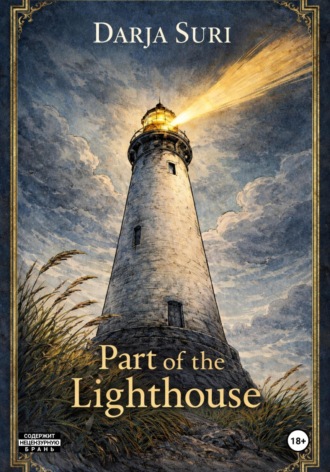
The old lighthouse stands on a small rise, where the wind often moves freely, sometimes producing sounds like cries of despair. Its white paint has peeled badly in places, revealing gray patches of concrete beneath. The cloudy glass is covered with a thick layer of dust and caked-on dirt. Rust has eaten into the metal bolts and railings. The nearly faded grass around the lighthouse is cut short, and not far from it a worn footpath runs through the ground. At the base of the lighthouse, dry leaves gather, carried there by the wind. Across the road stand large willows, giving way to a small but dense forest, beyond which a pond and a park come into view. Occasional cars break through the hum of the wind.
Large but sparsely spaced willows line the road. In the warmer months, they conceal the park behind them, as if hiding its lush, blooming vegetation; in the colder seasons, they stand stripped to the point of indecency. On sunny days, light filters through the branches and leaves, shimmering and playing. The park stretches across dozens of hectares, and at its center lies a large pond, occupying nearly half of its territory. Winding paths lead around the pond, past a children’s playground, through a picnic area, across a bridge, and back to the park’s entrance. Somewhere off to the side, the municipal building comes into view.
At the center of the pond lies a small island, where seagulls and cormorants often gather, fighting for space on the dense grass, moss, and stones, and for the bread thrown to them by elderly women. They feed the birds despite one of the park’s rules — “Do not feed the birds” — which is broken so often that it has long since been forgotten, as if it had never existed at all. At times, the birds make so much noise that they can be heard from the park’s entrance.
January
Winter arrived late, but within just a few days, an entire season’s worth of snow fell. At first, the snow lightly dusted the roads and grass. People continued to walk their dogs and circle the pond, burning off calories to satisfy their activity trackers. But the snowfall did not stop, and soon the drifts reached calf height, making every movement heavy.
Nicholas arrived at the park on a small snowplow. He was notified too late that the main paths needed clearing, and after the machine, the bridge still had to be cleared by hand. He set to work reluctantly, having failed to complete his morning ritual — a cup of espresso.
The day had gone wrong from the very start. In the morning, he had argued with his wife; later, he slipped on the ice and smashed his watch — a gift from his mother. A while after that, while clearing the road near the forest, he failed to notice a sapling planted a few months earlier and knocked it over. He cursed. Everything slipped from his hands, and his thoughts kept replacing one another, forming an endless kaleidoscope.
The past year had been difficult. Too much had piled up. Now Nicholas catches himself thinking that he is tired — tired of the snow, of the work, of the constant setbacks, and perhaps even of his wife. He lingers on the fallen sapling for a moment before moving on.
February
The thermometer no longer drops below minus ten, and the sun appears a little more often than once a week, though it still provides no warmth. The air feels lighter, and it seems that hope is beginning to stir in people again.
Men hurry through the park carrying brightly colored bouquets. Some walk with their heads held high, confidently holding heavy, lavish flowers. Others are awkward, dragging along small, hastily assembled bunches.
The sun sets, and in the darkness only the blinking light of the lighthouse remains — the one thing that does not go out.
March
Tom walks through the park, shuffling his feet through the slush. Disheveled hair, untied shoelaces, an unzipped jacket, and in his hands — a slightly crumpled stack of papers. Large dark circles under his eyes and a worn-out look have become his defining features.
He stops at another lamppost, pulls out a strip of tape, bites off a piece, and puts up a notice: “Have you seen me?” From the low-quality photograph looks an attractive, smiling young woman with long, chocolate-colored hair and bright, glowing eyes. Below it are her age, a brief description, and contact information — “Last seen in the park area.”
Конец ознакомительного фрагмента.
Текст предоставлен ООО «Литрес».
Прочитайте эту книгу целиком, купив полную легальную версию на Литрес.
Безопасно оплатить книгу можно банковской картой Visa, MasterCard, Maestro, со счета мобильного телефона, с платежного терминала, в салоне МТС или Связной, через PayPal, WebMoney, Яндекс.Деньги, QIWI Кошелек, бонусными картами или другим удобным Вам способом.