


Полная версия
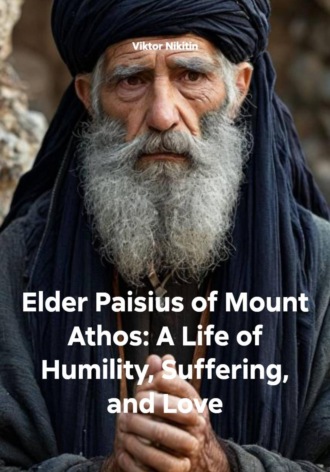
Elder Paisius of Mount Athos: A Life of Humility, Suffering, and Love

Viktor Nikitin
Elder Paisius of Mount Athos: A Life of Humility, Suffering, and Love
Venerable Saint Elder Paisius, known in the world as Arsenius Eznepidis, was born on July 25, 1924, in Pharasas of Cappadocia in Asia Minor, on the feast of Saint Anna. His birth took place in a deeply Orthodox and close-knit Christian community that would soon be uprooted by historical upheavals. His father, Prodromos Eznepidis, served as the chairman of Pharasas and was widely respected for his integrity, courage, and strong sense of responsibility toward his people. He was especially known for his profound reverence for Saint Arsenius of Cappadocia, toward whom he showed unwavering devotion. Out of both faith and careful attentiveness, Prodromos recorded accounts of the Saint’s miracles whenever he witnessed or heard of them, preserving them for the spiritual benefit of his family and children.
Prodromos was also marked by strong patriotism, which repeatedly placed his life in danger. At that time, the greatest threat to the Pharasiots came from armed Turkish bandits, and his leadership role exposed him to constant risk. Arsenius’ mother, Eulampia, was a woman of faith and quiet endurance. Together, the couple raised a large family of nine children, within which Arsenius was nurtured in an atmosphere of prayer, struggle, and deep respect for the Church.
On August 7, 1924, just one week before the forced departure of the Pharasiots from their homeland, Saint Arsenius of Cappadocia baptized all children who had not yet received the Mystery of Baptism. Among them was the infant Arsenius. Although his father initially followed family tradition in proposing the name of the child’s grandfather, Saint Arsenius firmly insisted on giving the child his own name, prophetically indicating a spiritual succession. This act was not accidental; the Saint, endowed with spiritual discernment, foresaw the child’s future calling and recognized him as one who would inherit his spiritual legacy. From the very beginning of his life, Arsenius was set apart for a path of complete dedication to God.
Five weeks after the baptism, on September 14, 1924, the Feast of the Exaltation of the Holy Cross, the refugees endured a difficult and painful journey by sea. Their ship eventually reached the Greek port of Saint George in Piraeus, where they remained for three weeks under harsh conditions, confined behind barbed wire. They were later transferred to Corfu, settling temporarily in the area of Kastra. Saint Arsenius, as he had foretold, lived for forty days on the island and reposed on November 10, 1924, at the age of eighty-three. With his passing, he left behind a living continuation of his spiritual inheritance in the young Arsenius, who would later become Elder Paisius.
As he grew, Arsenius showed an early and intense love for Christ and the Mother of God. Even as a child, he longed for the monastic life and expressed a strong desire to dedicate himself entirely to God. His parents, responding with affection and prudence, told him that he could pursue monasticism once he was grown, playfully suggesting that maturity would be marked by the growth of his beard. Taking this seriously in his childlike simplicity, Arsenius would rub his cheeks regularly, hoping his beard would grow sooner.
From a young age, he sought solitude and prayer. He often went alone into nearby forests, where he prayed quietly, holding a wooden cross he had carved himself. These moments of silence and personal prayer shaped his inner life and revealed an early inclination toward ascetic struggle and spiritual discipline.
After the family settled in Konitsa, Arsenius completed public school, receiving a certificate that reflected both solid academic performance and exemplary behavior. Before entering military service, he worked as a carpenter, a trade he embraced with humility and diligence. His work was marked not only by skill but also by compassion. When families ordered coffins for deceased loved ones, he refused payment, sharing in their grief and seeking to ease their suffering through quiet acts of mercy.
In 1945, Arsenius was conscripted into the Greek army. During his service, he became known for his calm temperament, courage, and self-sacrifice. He consistently volunteered for the most dangerous assignments, choosing personal risk rather than allowing others—especially married men with families—to be exposed to harm. His sense of responsibility toward others defined his conduct throughout his military years. On multiple occasions, he endangered his own life to rescue fellow soldiers, acting with determination and selflessness.
Most of his service was spent as a radio operator, a role that required attentiveness, reliability, and composure under pressure. In 1949, he completed his military service and was awarded a certificate rating his conduct and performance as excellent, bringing to a close a formative period marked by discipline, sacrifice, and quiet heroism.
* * *
The First Years of Monastic Life
As soon as his military service ended, Arsenius turned decisively toward the path he had long desired. Without delay, he traveled to the Holy Mountain of Athos, resolved to begin his monastic life there. For several months he lived in what monks call the Garden of the Theotokos, immersing himself in the rhythm of prayer and ascetic struggle. Yet even in this sacred environment, his conscience troubled him. He was concerned that the lives of his sisters were not yet settled, and this sense of responsibility weighed heavily on him. Unable to find peace, he chose to return to the world for a time, postponing his monastic commitment out of love and concern for his family.
In 1950, after ensuring that his familial obligations had been addressed as best he could, Arsenius returned to Mount Athos with renewed determination. On his first night, he was warmly received at the Lavriot Cell of Saint John the Theologian, near Karyes, where he experienced the traditional Athonite hospitality offered to pilgrims and novices. Soon afterward, he made his way to the Skete of Saint Panteleimon, settling at the Cell of the Entry of the Theotokos. There he came under the guidance of Elder Cyril, a strict ascetic originally from Agrinio, who had been ordained in the Holy Land and had later become a disciple of the renowned spiritual father Papa-Panteleimon.
Life with Elder Cyril proved to be a decisive school of asceticism for the young novice. Father Cyril practiced intense fasting and long vigils, and Arsenius eagerly embraced this demanding way of life. He benefited deeply from the Elder’s example and instruction, and he longed to remain with him permanently. However, circumstances beyond his control prevented a formal agreement from being written that would allow him to stay in that cell. Recognizing this as God’s providence rather than a misfortune, Elder Cyril directed him to Esphigmenou Monastery, which at that time was known for its openness toward strangers and its spirit of brotherly kindness. Arsenius arrived there in 1950, and in 1954 he was tonsured and given the monastic name Averkius.
As a monk, Averkius devoted himself wholeheartedly to spiritual study and obedience. He loved reading the Lives of the Saints, the Paterikon, and especially the writings of Saint Isaac the Syrian, a book from which he was rarely separated. Even during sleep, he kept it beneath his pillow, as if to remain inwardly connected to its spirit. After completing his assigned obediences, he never sought rest for himself while others were still laboring. Instead of withdrawing to his cell, he went to help the other brothers so that their work might be finished sooner. He could not bear to rest while others continued to toil late into the night.
His love extended equally to all the fathers of the monastery. He made no distinctions, obeyed everyone without exception, and consistently placed himself below others in humility. He showed particular care for the weak and struggling, seeking quietly to support them through practical help and prayer. Averkius never trusted his own thoughts. With simplicity and complete self-renunciation, he submitted everything to his spiritual father, asking guidance in even the smallest matters. He prayed constantly that God would enlighten his elder, so that he himself might be led in a way pleasing to God.
Конец ознакомительного фрагмента.
Текст предоставлен ООО «Литрес».
Прочитайте эту книгу целиком, купив полную легальную версию на Литрес.
Безопасно оплатить книгу можно банковской картой Visa, MasterCard, Maestro, со счета мобильного телефона, с платежного терминала, в салоне МТС или Связной, через PayPal, WebMoney, Яндекс.Деньги, QIWI Кошелек, бонусными картами или другим удобным Вам способом.