



Полная версия
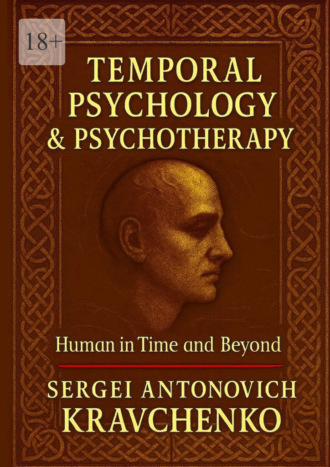
Temporal Psychology and Psychotherapy. The Human Being in Time and Beyond
___
Visual Symbols of Timelessness
In world culture there is a set of signs and ornamental devices that can, with a fair degree of justification, be interpreted as visual «symbols of timelessness» – that is, they figuratively represent not just eternity or cyclicity but the absence of duration, limit-as-emptiness, a state «before time» or «outside time.»
A necessary warning at once: most traditional symbols are more naturally read as signifying eternity/cyclicity/wholeness than literal «timelessness.» Translating such images into the term «timelessness» always requires careful hermeneutics (contextual clarification). Below is a selection of candidates with brief explanations indicating why they can (or should not too hastily) be considered symbols of timelessness.

Candidates for «Symbols of Timelessness»
Candidates for «Symbols of Timelessness» (with Explanations)
1. Ensō – the circle of «emptiness» in Zen (Japanese brush painting).
Why it fits: Ensō is at once «emptiness,» «wholeness,» «moment,» and «nothing.» In certain interpretations it points to a no-mind state freed from ordinary temporal narration – closest to the experience of atemporality. In other contexts, however, ensō symbolizes wholeness/eternity, so its meaning is multilayered.
A possible reading for our context: «Circle-emptiness: ensō with a bindu – a symbol of a state beyond duration.»
2. Śiva-point / bindu (Indian tradition, tantra, mandala).
Why it fits: Bindu is the point of origin, the «seed» from which the manifest arises. As a «source-point» it can signify a pre-temporal state, where extension has not yet begun. In visual sequences, bindu is often opposed to the extended structures of the mandala; this polarity is well suited as a metaphor of «before-time.»
3. Images of the primordial abyss / primordial chaos
(e.g., Nun in Egyptian cosmology; the gap Ginnungagap in Norse mythology).
Why it fits: Myths of «primordial waters» or an «empty chasm» are cultural descriptions of the pre-creation state, when there is no extension, no time as such. Visual representations of these myths (wave-like motifs, dark abyss) can be read as signs of timelessness.
4. The «empty throne» / aniconic absence
(in early Buddhism, Christian iconography – hetoimasia).
Why it fits: The empty throne as a sign of an absent presence is not an image of eternal duration but a symbol of absence (of that which cannot be depicted). It opens a space of «non-representation» that is close to the idea of something beyond the temporal category. In early Buddhist iconography, the absence of an image of the Buddha conveyed transcendence.
5. Black Square (K. Malevich) – the «zero point» of art / sign of non-being-as-potential.
Why it fits: In the avant-garde of the 20th century, Black Square became a symbol of «nothing/beginning/zero point,» a laconic indication of the overcoming of objecthood and of the «emptiness» from which a new form is possible. It can be read as a modern ornamental metaphor of a state outside ordinary temporal coordinates. The black screen of a phone, tablet, or computer can serve as a similar symbol today.
Конец ознакомительного фрагмента.
Текст предоставлен ООО «Литрес».
Прочитайте эту книгу целиком, купив полную легальную версию на Литрес.
Безопасно оплатить книгу можно банковской картой Visa, MasterCard, Maestro, со счета мобильного телефона, с платежного терминала, в салоне МТС или Связной, через PayPal, WebMoney, Яндекс.Деньги, QIWI Кошелек, бонусными картами или другим удобным Вам способом.